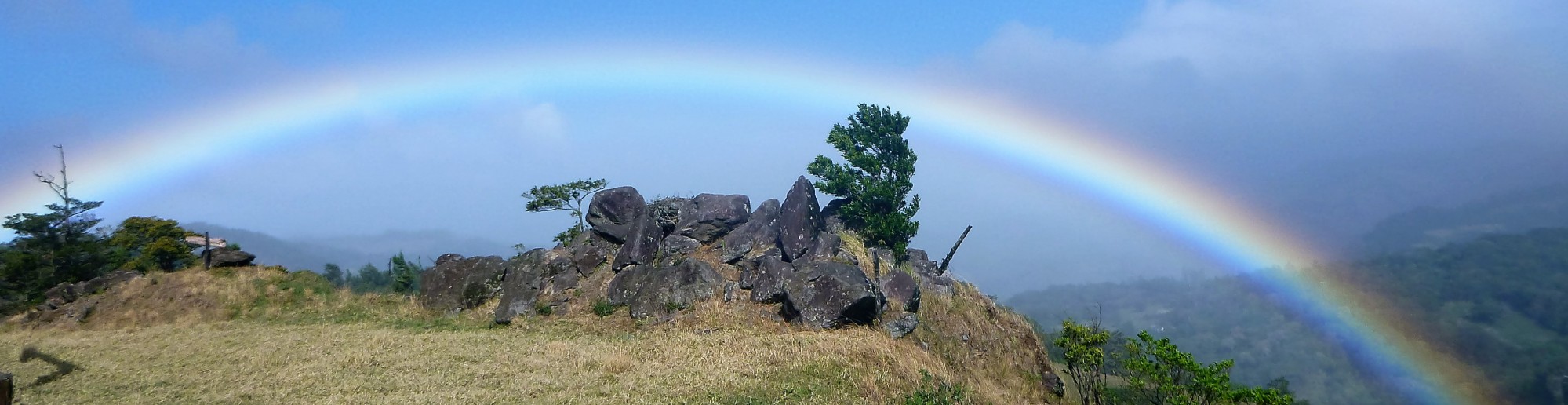

Route = Shivalaya (1784m) – Deurali Pass (2705m) – Bhandar (2104m) – Kinja (1600m)
Date = 06-07 March
It’s a pleasant 12°C as L cleans her teeth at an outdoor sink, spitting toothpaste into the dirt. She can’t spit into the sink as their host is washing his trousers.
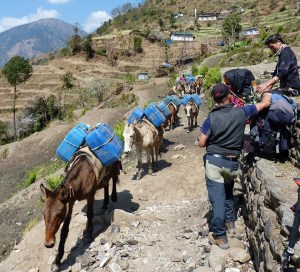
She watches Phurba tie rope around their 25kg kit bag, add his own much smaller backpack and then pick the whole thing up suspended from his head by a band of webbing. He leans forward into the weight and lopes off, arms hanging down in front of him as counterbalance. L is aghast.
L: Angtu! He can’t possibly carry all our stuff like that! From a single point on his head! Hanging by a piece of string! We must do something!
Angtu looks a bit surprised.
L: I thought he’d have a rucksack. We must get him a rucksack!
Angtu: He doesn’t want one. He prefers it like this. All porters carry like this.
L: Surely it would be so much better to spread the weight through his shoulders and hips. What about his poor neck? And his back?
Angtu shrugs and smiles politely.
L is mortified. She wonders if she should turn herself in for human rights abuses. She can’t bear to look at Phurba – at what she has done to him. D steps in.
D: It’s a tumpline. People have used them to carry stuff, all over the world, for ever.
L: But not any more! There are modern alternatives.
D: Patagonia uses them.
L: The country?
D: It’s not strictly a country. Never mind. The posh outdoor equipment company. Their founder swears by them.
L: Oh.
D: Look – if you don’t know what you’re doing, and you need to carry a weight, you’re less likely to injure yourself with a backpack. But if you do know what you’re doing, it’s a different story.
L: What d’you mean?
D: The general opinion is that it’s physically healthier and more efficient to use a tumpline. You need to learn the proper posture and technique, and to build up your neck and back muscles. But once you do, it’s better for you.
L: How can it be?
D: It spreads the weight evenly down the strongest bits of your body. And it doesn’t squash your lungs. And in an emergency it’s a lot easier to throw off than a rucksack.
They look ahead to where Phurba is stepping lightly and sure-footedly up the trail ahead of them, singing loudly to himself.
L: So d’you think he knows what he’s doing?
D: Looks that way to me.
Under a clear blue sky, they climb the hillside high above Shivalaya, the blue and silver of corrugated tin roofs glinting below their feet in the sunlight. Strains of music from a wedding procession drift up from the village – the steady beat of drums and the unruly joy of a trumpet. At one end of the river valley, in the far distance, snowy peaks rise up, beckoning. As the gradient steepens, the terraced fields become ever smaller, like vertical ripples in a pond of vibrant green buckwheat. Fruit trees are in blossom and the white petals of huge magnolias speckle the forested hillsides.
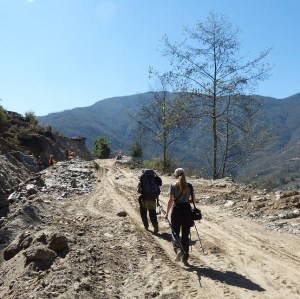 Angtu sets a steady, sustainable pace, leading the way, and L is relieved that she can keep up. Phurba walks with them, and the two Nepalis chat and laugh their way up the hill. They cross, and recross, and briefly follow the road. The road is not actually a road, but a road-sized sandy ribbon, winding its way ever deeper into these hills, promising long-awaited access for remote villages to schools and doctors, markets and jobs. For now though, the only people on it are builders and engineers and surveyors. Those on foot keep away – there is too much dust and not enough shade – and no-one has a vehicle anyway.
On a grassy slope a handful of goats and cattle graze. They pause at a tidy paved courtyard between low wooden buildings and venture inside. The small room is blackened with smoke from an open fireplace which has no chimney. On the walls hang tin mugs and gleaming pots & pans. They sit at a bench and sip hot sweet tea. Angtu acts as go-between as their hostess offers a taste of curd – a slightly fermented yoghurt – and a ricotta-type cow’s cheese she has made. 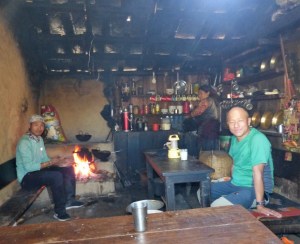
Angtu: We have a very special type of cattle here in Nepal. Very high milk yield. Called Jersey Cow.
D: Oh! We have those! They come from an island, just off the coast of Britain. Called Jersey.
Angtu looks sceptical but says nothing. Their hostess tells them they keep the cow for milk and goats for meat. They grow buckwheat, maize, potatoes and vegetables. They talk about the road. Progress has come swiftly to this area – in just a few years they have also seen the arrival of hydroelectric power, satellite TV, and wifi. Sanitation, though, remains simple. Most dwellings have a separate wooden outhouse, with a hole in the floor, placed at the edge of a field. The waste collects below and is then raked onto the field and used as fertiliser to grow potatoes.
They carry on, ever upwards, on stony paved and stepped paths, now through scrub woodland, to reach the dusty expanse of the Deurali Pass. A few buildings and lodges huddle in the stiff breeze.
Angtu: Left! Go left!
D pauses, startled, looking for hazards in the path.
Angtu: Look – you must pass to the left here. Always clockwise.
At the centre of a clearing are five long double-sided mani walls, hundreds of metres of carved stone tablets inscribed with the sacred Buddhist mantra “om mani padme hum” or “hail to the jewel in the lotus”. 
L: Why left?
Angtu looks at her in astonishment, then explains patiently.
Angtu: Because that is the path of the world, of course. Everything in our universe moves clockwise.
L: Of course. Stupid.
D: Stupid.
It’s time for lunch. D&L sit determinedly in the sun, adding layers of clothing and eating dal bhat. Angtu and Phurba head indoors to sit by the warmth of the kitchen hearth.
As they begin their long descent into the huge green Bhandar valley, D stops.
D: Take a photo!
He stands excitedly beside a small lopsided signpost announcing “Way To Everest”.
L: But it’s only day 1. We’re over three weeks walk from Everest.
D: I know, but we’re on our way. The signpost says so!
Later Phurba stops and rests his load on a wall. He points at a long low wooden shed with a tin roof, and says something to Angtu.
Angtu: It’s a school. For your pencils?
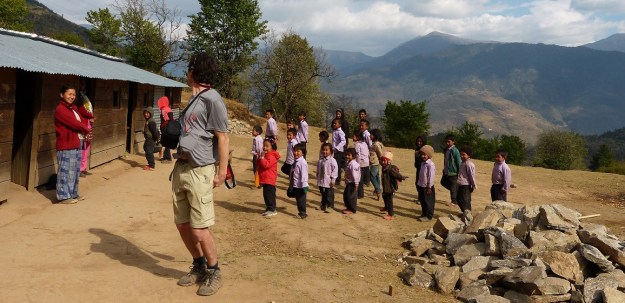
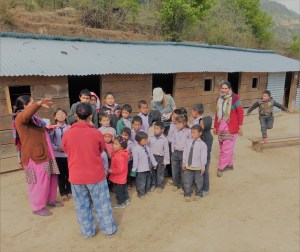 L&D have filled their pack with coloured pencils and crayons to give to village schools. They walk across the dusty yard, where a number of tiny children in lilac shirts and dark trousers are emerging from the building. They have crocs on their feet and a few are wearing ties. L&D greet the three female teachers. They rummage in their pack and hand out pencils and crayons as the kids crowd around them. The teachers explain that the school has 25 pupils aged between 6 and 15, though today there are only 20. They seem younger, none of them much older than 9.
The children are arranged into rows. Despite the interruption it is time for their exercise class. One of the older boys stands at the front and calls out numbers in English, one to nine, as he leads them through a series of star jumps, squats, toe-touches and stretches. D joins in. The children begin to stare, then giggle. The caller proudly continues his routine and his audience follow, but all eyes are on D. The teachers laugh out loud and get out their camera phones. Angtu and Phurba look on, amused.
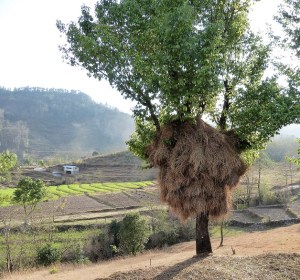 Bhandar is idyllic – a widely spaced scattering of attractive stone buildings on a gentle slope of green meadow. It was badly damaged in the earthquake of 2015 and lots of rebuilding is going on. The lodges around the central square are full of road-building engineers, so they continue to the very bottom of the village. At their whitewashed, blue balconied lodge, sunshine streams through the windows. The mattresses are very thin. Downstairs there is one indoor squat loo, but no water has been provided.
L: Angtu – umm…is there a bathroom?
Angtu: Outside. Toilet and also a shower.
On a paved terrace sit several girls, one braiding the long dark hair of another. Beyond them is a tin outhouse with two doors. In one is a squat loo, bucket of water and jug, and in the other a concrete floor and electric shower. At a corner of the terrace is a concrete sink and cold water tap. These facilities are shared between all guests and family members. L has a shower. The water is tepid and the overwhelming smell of pee from next-door makes her gag, but she is not to know that warm water from a shower head will become a rare treat indeed.
Having eaten dal bhat once today already, they opt for pasta for supper. It’s a mistake. They are still feeling their way.
***
The next morning they sit on the terrace in bright sunshine. Angtu looks bleary.
Angtu: I am so sorry. Very bad night.
D: Really?
Angtu: Very drunk Nepali. I think he was an engineer. All that talking and singing and snoring. Then he would stop. Then he would start again. This is not normal.
D: We thought maybe it was always like that. We just put in our earplugs. We slept well.
 They drop towards the river, peeling off layers of clothing as they go. The day is warming up under a strong sun. A track winds around the hillside, where deep red rhododendrons and pink-blossomed fruit trees are in flower. They descend through wet, irrigated gullies of cardamom plants. As they dash to dodge the sprinklers Angtu explains.
Angtu: They need a lot of water!
L: Do Nepalis use cardamom for cooking?
Angtu: No – they sell it all to India and China for medicines.
D: It’s one of the most expensive spices in the world. I think only vanilla and saffron cost more.
L: That’ll be why they don’t use it themselves – it’s worth too much. Like saffron in Italy – it’s quite difficult to even buy it where it’s grown – it’s all carefully packaged up and exported.
Further on, they spot a toddler clinging to a rock built into a stone wall on the steep bank above the path. She appears to be alone. Angtu speaks to the little girl. She replies eloquently, with great dignity. Angtu scrambles up the bank, carefully picks up the child, gives her a gentle pinch on the cheek, and lifts her over the wall. He puts her down, she turns and thanks him and scampers off as her mother appears. She had been looking for a good piece of firewood and got stuck – unable to either get back up the wall or down the steep bank.
They reach the village of Kinja at lunchtime and eat dal bhat outside a smart-looking guest-house. A sign boasts “hot shower” and “attached bathroom”. That does it – they decide to go no further.
Angtu chooses their room, which needs cleaning. He attempts to rally the chatty young hostesses, then does it himself with a dustpan and brush and Phurba.
The hostesses prove to be better at sign-writing than provision of service. The “attached” bathroom is attached to the building, not the bedroom. It’s downstairs, with a squat toilet and shared with the rest of the building’s inhabitants. “Hot shower” translates to “washing up bowl of boiling water into which you add cold water from the loo flush bucket and stand in a shower tray next to the squat loo”. D&L bathe in the washing up bowl and are careful not to step barefoot into the adjacent squat toilet bowl.
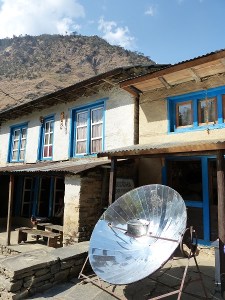 Kinja sits where a confluence of rivers force a widening of the valley floor. There are enormous boulders strewn about, possibly ancient remnants of glacial moraine, as they do not appear to have tumbled from the mountainsides above. The village was badly shaken by the earthquake and there is plenty of construction taking place. A couple of boys clatter past, to and fro along the neatly paved alleys, with wheelbarrows full of building stone. The end wall has fallen off a house nearby, and another is crumbling and abandoned, used only to tether a goat from a doorpost. Laundry is spread out on a woodpile to dry, and a solar kettle reflects the sunlight from its enormous mirrored dish to a blackened pot suspended at its centre. Flowering nasturtiums crawl over a low wall and a cactus tree provides an incongruous foreground for the distant snows beyond.
They are now drinking local water – sourced from it hardly matters where. D first carefully squeezes it through a filter and then adds purification tabs for good measure. It is failsafe and tastes no worse than London water. Over the course of their trek it will stop them needing to buy and dispose of around 120 plastic bottles of water.
As the afternoon wears on, L begins to feel feverish and cold. She wraps up in excessive layers of clothing and has porridge for supper.
 D&L wait patiently outside the guesthouse for Angtu, Phurba and the hostesses to finish flirting and taking selfies with each other. The sky is cloudless but a little hazy. They climb steeply passing isolated dwellings in impossibly inaccessible places, frilled all around by the narrowest of terraces – some barely a metre wide. Under one spreading tree – a cloud of white blossom – a man slowly drives a pair of cattle and a wooden plough through the dusty earth.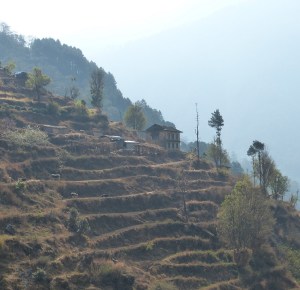
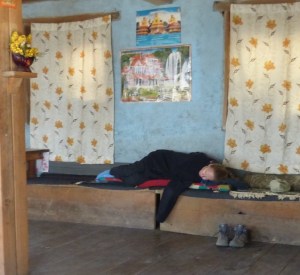
 Unlike yesterday’s balmier climes, it is 4°C in their bedroom this morning. They poke their noses out of the nest of bedclothes.
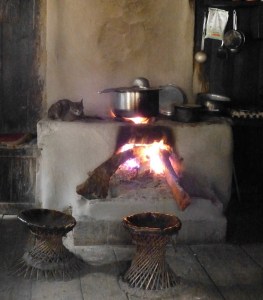 Eventually the terrain flattens and opens into wide alpine meadows with cattle enclosures. At the edge of Taktor they pause at a tea-house. On a wall is a large basket – a doko – full of rhododendron leaves collected from the forest for cattle fodder. Indoors a cat sits on top of the hearth, next to a cauldron of hot water. Their hostess prepares noodle soup – feeding the fire carefully with wood, and removing it again once it has served its purpose – preserving it as a scarce resource.

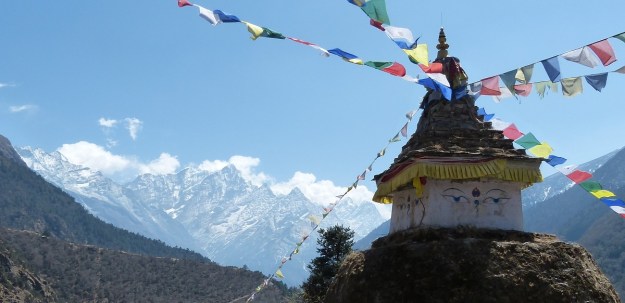
 High above Jumbesi, below the monastery, towers an immaculate white and gold stupa. Four layers of niches wrap around the circumference, and in each little midnight-blue alcove sits a tiny golden Buddha. Prayer flags stream from the pinnacle in all directions. Mani stones, mantra-covered boulders, and prayer wheels mark the onward route.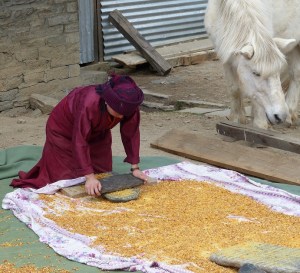
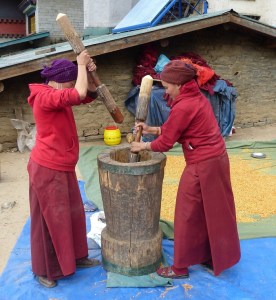 In one courtyard nuns have spread maize kernels on large tarpaulin sheets. One is kneeling, crushing the kernels under a rock, whist a shaggy white pony stands at her shoulder hoping for a meal of husks. At a waist-high wooden pestle and mortar, the maize is further ground by two more nuns, heavy wooden clubs raised and lowered, pummelling rhythmically, wood on wood.
 D: A black dog!
 The following morning they try again.
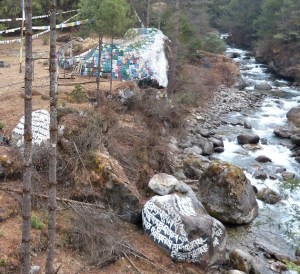 The day is overcast but dry. The landscape is beautiful – a gentle path undulating around meadowy hillsides, through clumps of fir trees, past grazing cattle and (clockwise) around stupas and prayer flag poles. They cross a river on a swaying steel suspension bridge above a group of mani boulders painted in multi-coloured mantras. Despite the mild gradient and the fact that they are still at well under 3000m, L walks slowly, panting like crazy, as though her lungs are battling the thin air of high altitude. She is coughing so much that her chest hurts and her stomach muscles are sore. The three hour walk to Ringmo takes five and the final 200 metre climb finishes her off. She staggers into the first guest house they come across.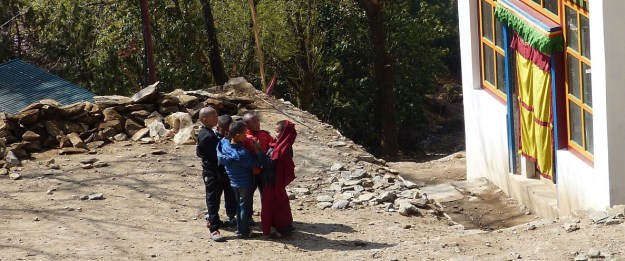
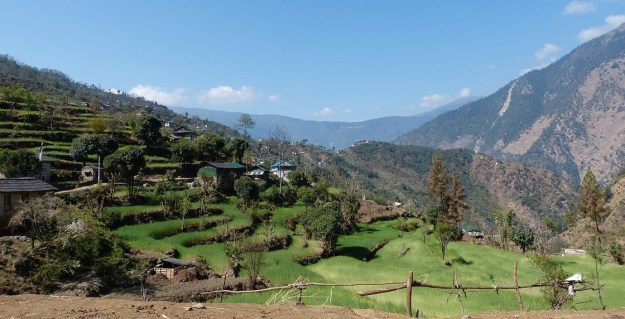
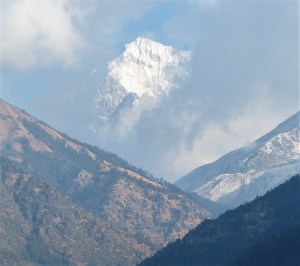 The early morning light drapes the hillside with a chilly blue hue, but the sky above is clear. In the distance a curtain of morning mist opens briefly to reveal an immense white pyramid, and then closes again, as though they imagined it. They climb steep cobbled lanes, past orchards and neatly fenced paddocks, and, still cobbled, still steep, on a sunken lane through woodland. At the top a covered gateway leads them to the Trakshindu La. The 3070m pass is scruffy and windswept – a bare earth farmyard with a lodge, barns and animal enclosures. Contradicting all outward appearances, inside the lodge dining room every table has a pretty cloth and a vase with fresh flowers. Near the door is a huge copper basin filled with water, in which freshly picked marigolds float on the surface. An elderly woman arranges them lovingly. It is entirely unclear where in this harsh landscape these flowers could possibly have come from, or whom they are for.
 The trail becomes punishingly steep, a waterfall of dust and boulders. They continue down, glad of knee supports and trekking poles. Below, they can hear, and then see, an icy blue river and a huddle of huts. This river is their first glimpse of the Dudh Kosi – which they will follow for the next two weeks, all the way to its source, where at 4,700 metres it flows from the Ngozumba Glacier through Gokyo’s sacred lakes.
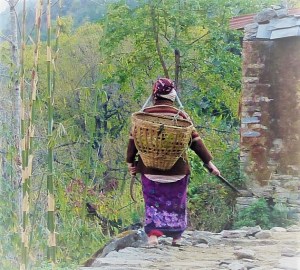 Angtu has been firm again, and in the morning they are on the trail by 7.30am – heading uphill pretty much all day. The landscape is stunning, the sky is blue, and the temperature pleasant. They wish they could dawdle – taking two or even three days to cover the ground instead of just one. Ahead on the path a woman, stick in hand, gracefully flicks cattle dung from the ground into a doko basket on her back. Bamboo, fruit trees and even the occasional palm grow beside the trail. Angtu and Phurba chat and laugh. Phurba sings and quacks like a duck.
 At the top of a steep flight of stone steps they pass through a monastery gateway. There is a choice – more steps to the gompa itself, or a pause for a tea-stop. L opts for tea and basks in the sun. D heads for the steps. At the top, prayer flags flutter and the gompa door is open. Inside, his socks slide on the polished wood floor. The walls and ceiling are alive with colour, shapes and patterns. Layers of fabric forming cylindrical frills, in reds, greens, yellows, blues and white, hang from the ceiling. One wall is made up of niches for prayer books. Two green-skinned drums stand sentinel over low cushioned benches for monk meditation. Outside again, the sunlight is dazzling and the lush green valley is spread out at his feet.
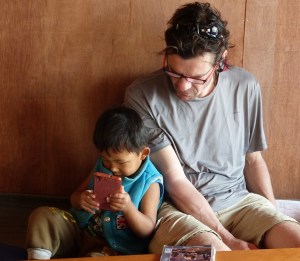 In a tea-house in Bupsa they order noodle soup and omelettes. The owner’s tiny son shares a bench with D, playing a game on his mother’s phone. He edges along the bench, studiously ignoring D. D peers towards the screen and gives advice. The boy takes no notice, loses the game and slides closer to D. They both study the screen. The boy loses the game. He hands D the phone. D loses the game. The boy rolls his eyes and reclaims the phone. He loses the game. The boy gets comfortable, turning sideways, leaning back, using D as a back rest, feet on the bench, phone on his knees. D drinks his tea. The boy loses the game.
 They climb back up the bank and onto the path, still behind the donkeys, and follow them into Paiya. At the entrance to the village there’s another hold-up. A workman has left a hammer on the narrow metal bridge, and there is no way one particular donkey is stepping over that hammer. No way. After some ineffectual shouting and pushing, the hammer is removed and the donkey train continues.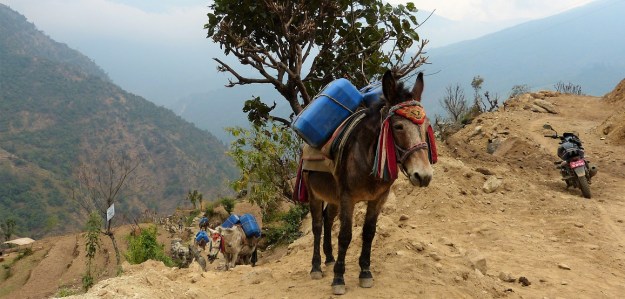
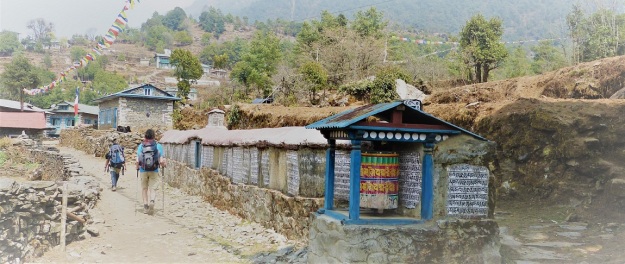
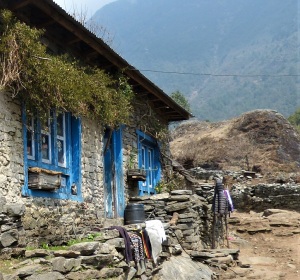 They come to Moshe, a medieval-looking collection of tiny stone cottages and doorways in rock-faces. The land is worked – divided into little stone-walled fields and compounds. There are no shops or lodges or tea-houses. More than anywhere they’ve walked through so far, this place seems utterly untouched by tourism and modernity, separate, forgotten. Lukla’s town and airport are invisible and yet just a few hundred vertical metres above them. They are right in the flight path. Some days 1000 people pass over their heads, but each is oblivious to the other. They are worlds apart.
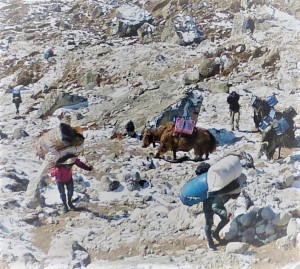 There is also a hybrid third group – the expedition porters. These guys tend to look and dress like trekking porters – young, fit and reasonably well equipped. However, it seems that they too are paid by the kilo as they carry ludicrous loads, the furthest distance, to base camps at the foot of the world’s highest mountains, covering many miles a day. They are doubled over under towers of chairs, rolls of carpet, steel folding tables, mattresses, drums of climbing gear, cooking gas cylinders, pots and pans. It’s seasonal and punishing work, but lucrative if they can get it.
 Angtu acts as translator and go-between, making sure they have everything they need.
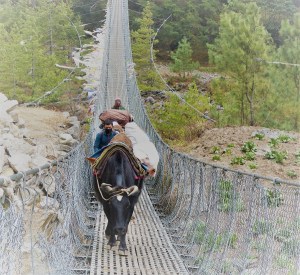 D: Are those yaks?
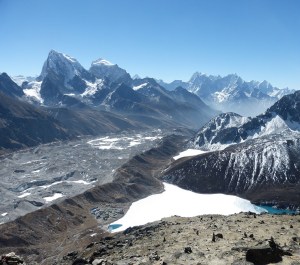 L: 3%. Hardly any. And guess how much is barren land over 5,000 metres?
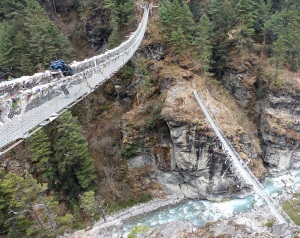 It’s still spitting when they make their way alongside the river bed, on a path of worn-smooth river stones. Ahead across the river are two long suspension bridges, one above the other, reaching from one hillside to the next. The lower one is no longer used. The higher one is a very long way up.
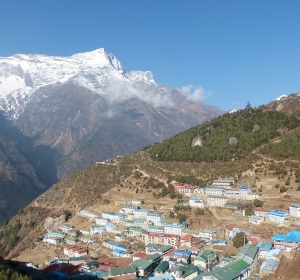 There’s good news – the hotel is giving Angtu free accommodation and meals.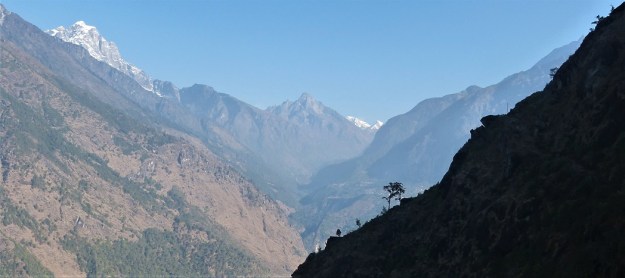
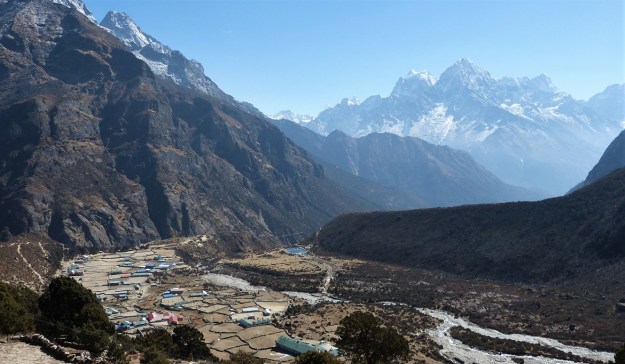

 He takes them up to a viewpoint above town. On the northern horizon, the clouds shift briefly.

 They cross the yak paddocks in Thame. Yaks are lying or grazing, wearing woven collars and big bells and wisps of crimson wool. On their withers is tied a white prayer-flag with Tibetan script printed in gold.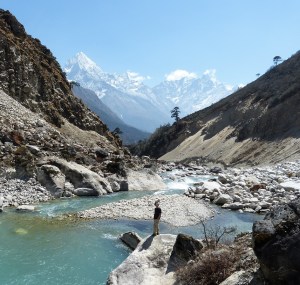
 A crumbling path rises vertically behind Namche Bazaar. Angtu groans loudly at intervals, grinning widely, as they climb 400 metres in under an hour, overtaking a steady stream of panting, less acclimatised trekkers.
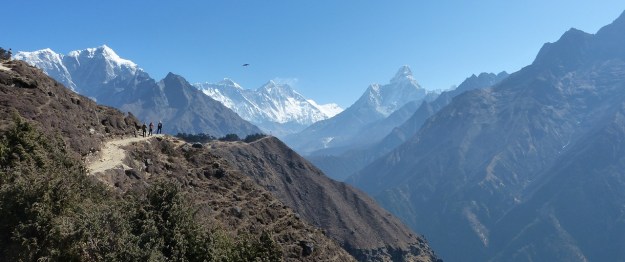
 All day they walk towards Ama Dablam pointing haughtily skywards, a backdrop to stupas, prayer-flags and picturesque yaks. It photo-bombs their pictures. It demands to be admired. It’s the most beautiful peak they’ve ever seen.
 Often, pushing trekkers too high too fast is simply down to a battle by tour companies to offer competitive prices and so a tightly timed itinerary. Sometimes though, the reasons are a lot more sinister. There are scams where companies deliberately cause their clients to become ill, with altitude sickness or food poisoning, and then call in a helicopter which delivers the trekker to a private hospital. There are plenty of winners – kickbacks for all – the trekking company and guide, the helicopter company and pilot, and the private hospital. There is also one big loser. The trekker gets a curtailed holiday, a life-threatening illness, a helicopter ride, a stint in hospital, and a gigantic bill.
 Birch and rhododendron woods line the path, moss hanging from tree branches and the river is occasionally visible far far below. Frozen waterfalls and torrents of snow and ice stripe the cliffs overhead and cross the trail, incongruous in the strong sunshine and soft woodland.
 L: And what are the symptoms? Apart from feeling tired and breathless.
 At a lonely teahouse skirted by stone-walled yak paddocks, they stop for tea. The sun gleams off the blue tin roof, the pristine whitewash and the silver dish of a solar kettle.
 At the top of the pass they enter a long valley strewn with boulders. They pass the first of Gokyo’s sacred lakes on which a pair of orange Brahminy ducks glide and preen on the metal-grey water. Further on they reach the second sacred lake. It’s fringed with decorative cairns, placed there by Hindus and Buddhists for whom these lakes have religious significance, or by trekkers taking selfies.
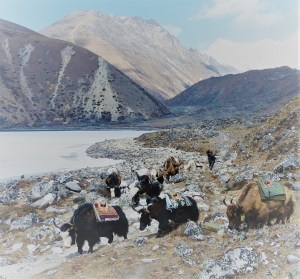 A train of yaks lumbers by, calmly picking their way across the rocky ground, and swinging their big gentle lethal-weapon heads from side to side. Some have untidy white face markings on otherwise black woolly coats, as though they have been apple-dunking in a trough of whitewash.
 In this remotest of backwaters is a cluster of trekking lodges. Their bedroom has a carpet, a lake view and clean linen on the twin beds. The internet works and there is a plug for charging phones. A skylight lets the sun heat the space in the day. They look in wonder at the en-suite bathroom with Western loo, a basin and a shower tray.
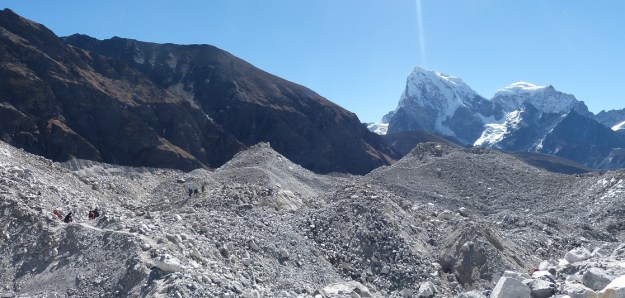
 L: (squeaking with excitement and breathlessness) Look at that – it’s enormous!
 D&L scramble and explore and take photos. They ceremoniously secure their tiny string of prayer-flags and imagine the prayers taking flight, like leaves, spinning and drifting across the magnificent scenery, spreading peace and wisdom, compassion and strength onto the world below. Then they just sit. And look. And take it all in.
 The terrain becomes more and more uneven, littered with stone, rocks, boulders. They pass the fourth sacred lake, a blank ice sheet against a barren brown hillside and cloudless cobalt sky.
 The glacier is forbidding up close, an apocalyptic moonscape of slow moving rock and ice, and unfathomably huge. From the flank of Cho Oyu it descends in a blue-white ice-fall, turning to stone as it reaches the floor, carving out a great grey gravel lake before creeping southwards along the valley to Gokyo and beyond.
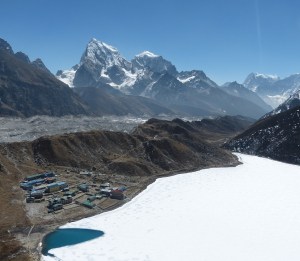 L: It’s the lake!!!
 A brief scramble behind the village brings them once more to the rim of the glacier. Today they’re going in. They look down over the edge. There is a steep slope of loose stone and scree and gravel and dust that they must descend to get into the glacier, in order to cross it. A couple of people are ahead of them, already at the bottom of the slope. They are tiny, ant-like. D&L shake their heads, trying to knock their brains into registering the scale of what they are seeing. There’s a scuffle and a hiss and a puff of dust below. Loose stones are rattling down the slope. D&L start downwards, skidding and sliding. Another flurry of pebbles tumbles across the path ahead.
 They continue, dropping down past the edge of a frozen pool of water. On one side rises a vertical wall of multi-layered ice, festooned with icicles and topped with a carpet of rubble. They stare in fascination at the cross section of glacier. A down-stream path leads them eventually to the foot of the moraine wall on the far side. Their exit is a vertical scramble over loose rock and stones and dust, all crumbling and slipping beneath the soles of their boots, until without warning they suddenly burst over the rim onto a grassy plateau. They are out.

 They set off at 5.40am. From behind Tagnag, a cleft climbs and widens, the shallow stream turning to ice as they gain altitude. Their fingers and toes become numb with cold. L fumbles to unscrew the lid of her water bottle. The cold air rushes in and the water quickly freezes. The temperature registers as minus 7°C. The sun rises and tantalisingly floods the mountainside above them but does not reach the trail. They reach a first pass of grey shale, at 5100m, then drop down into a huge parched-grass valley sprinkled with boulders. The views are magnificent but they remain in deep shade.
 Angtu: It’s better early, like now, before the sun. Later, when the ice melts it can be unstable. Sometimes there are rockfalls.
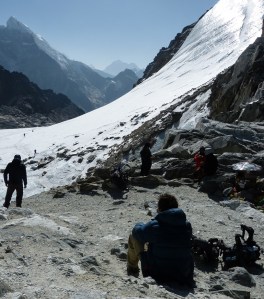 They sit in the sun at 5420m, feeling happy and healthy, and munching yak-cheese chapati sandwiches and Snickers and watching brightly jacketed ant-like figures making their way up the snowfield towards them.
 They take off their crampons and negotiate a narrow rocky snow-covered ledge high on one side of a steep valley wall. They should have kept the spikes on. It is icy and slippery underfoot and the fall would be long and uncomfortable. D watches nervously as ahead Angtu holds L’s hand as she skids and trips and wobbles along the path. Angtu leaves her wedged securely between two boulders while he doubles back to help a pair of independent trekkers also unsteady on their feet.
 On the far side of the valley, they come over a rise and arrive at Dzongla, a small cluster of scruffy corrugated iron farm-like buildings lying in a bleak little bowl. They are tired and hungry but triumphant to have survived despite the dire warnings of ice and falling rocks and crevasses. The lodge is busy but neither clean, warm nor fragrant – its only redeeming feature a beautifully crafted floor-to-ceiling tower of yak-dung in the hallway.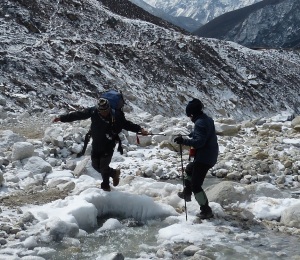
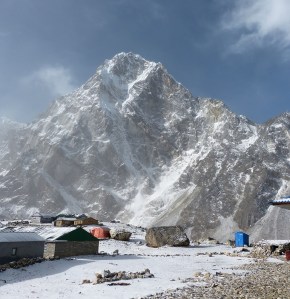 From the warmth of their sleeping bags, at 6.00am, they check the temperature in their bedroom.
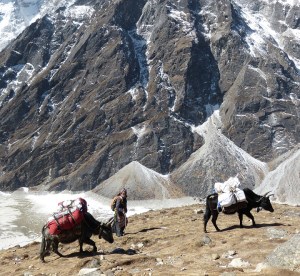 On a meadow-like spur they stop to admire the views. A woman walks past, driving her three yaks. She is wearing a traditional full-length skirt and headscarf and carrying a high-tech trekking backpack. The river meanders down the valley, back towards Lukla. To their left is an immense dam of glacial rubble – the stony front end of the Khumbu Glacier. At its foot, seemingly right in its path, cower the buildings of Dughla. To their right towers the craggy shoulder of Cholatse. Angtu and Phurba strike poses and photograph each other. Then they sit and eat biscuits.
 They turn their back on Cholatse to the west and Ama Dablam to the south, and head north towards perfect peak of Pumori. There are only a very few other people on their path, but below them they can see strings of tiny figures zig-zagging their way slowly up from Dughla, climbing the rough tongue of the glacier. This is the main Everest trekking route, and it’s busy.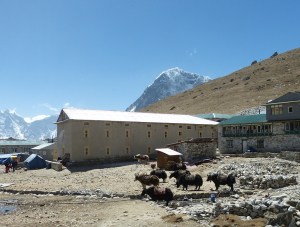

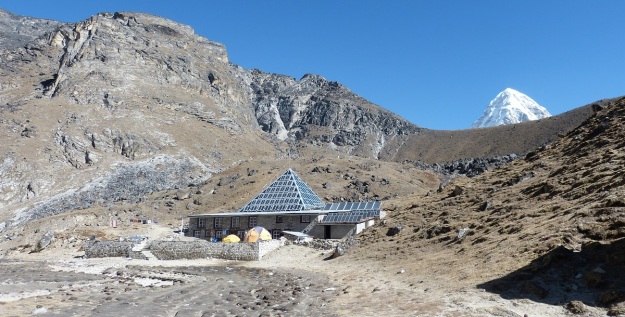
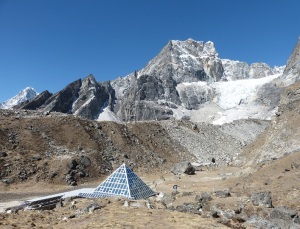 In a little barren side valley a solitary low stone lodge is half buried into the hillside and topped by a large glass pyramid sheathed in solar panels. Behind, in a perfect mirror image, rises the white peak of Pumori, and opposite, a glacier tumbles straight down the mountain into the valley. A few dumb-bells and makeshift gym equipment sit on a low wall. They are definitely in the right place.
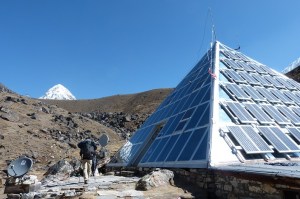 Kaji: We also collect geological seismic data – any earthquake activity.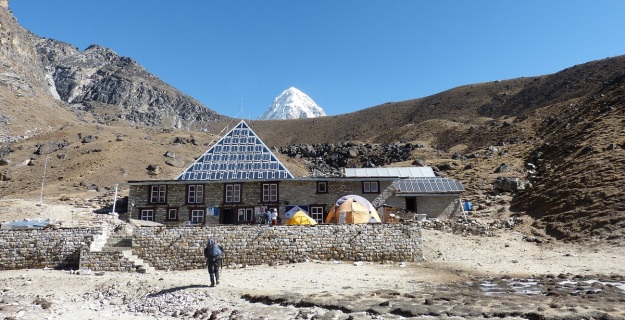
 And Then They Went