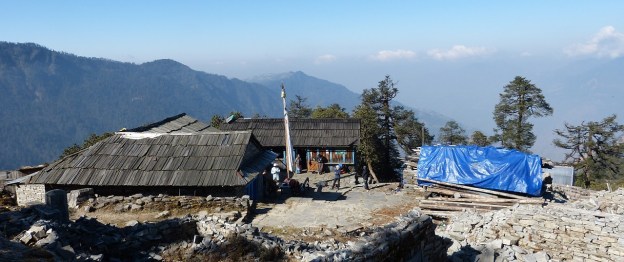
Route = Kinja (1600m) – Goyom (3220m) – Lamjura Pass (3520m) – Jumbesi (2680m)
Date = 08-09 March
D: How are you feeling?
L: Feverish.
L: And dizzy.
L: And weak.
L: And queasy.
D: Anything else?
L: I’ve got a splitting headache.
D: Drink this. It’s hot lemon tea. I’m going to cure you.
D inspects the contents of his first aid kit and pill boxes. He hands L a handful of tablets.
D: Here.
L: Which one?
D: All of them.
L: Oh – OK.
She gulps them back, grimacing and retching into her hot lemon mug.
L: What were they?
D: Lemsip Max-Strength.
L: Good.
D: And one of those magic anti-nausea pills.
L: I like those ones.
D: And a Valium, just in case.
L: Blimey! I like those ones too. Will that help?
D: Dunno. But I’ve got to get you up a very big hill.
 D&L wait patiently outside the guesthouse for Angtu, Phurba and the hostesses to finish flirting and taking selfies with each other. The sky is cloudless but a little hazy. They climb steeply passing isolated dwellings in impossibly inaccessible places, frilled all around by the narrowest of terraces – some barely a metre wide. Under one spreading tree – a cloud of white blossom – a man slowly drives a pair of cattle and a wooden plough through the dusty earth.
They are passed by an incongruously dapper image, walking fast downhill, dressed in a tight-fitting cream suit, and carrying a spear with woollen tassels hanging off it. They look enquiringly at Angtu.
Angtu: Shaman. Witchdoctor.
D: Where’s he going, d’you think?
Angtu looks a bit puzzled.
Angtu: Back to the village. Every village has a shaman. It gets passed down from father to son.
D: But what do they do?
Angtu: They help people with their problems. Sometimes a physical problem, sometimes mental.
L: Does your parents’ village have a shaman?
Angtu: Of course. One of my aunties, my father’s sister, died young. She had left the village because of her marriage, but was brought home and was buried on our family land. But our village shaman said that my auntie was a witch, and that because we had buried her on our land, it would make our family and the village sick. And then our whole family and the village became sick! Then the shaman said my auntie would have to be cremated. So they dug her up again.
L opens her mouth, wonders what on earth she should say, and closes it again.
Angtu: And they found that although her body had decomposed, she had beautiful white shiny teeth and beautiful clean curly hair. The shaman told us her teeth had been biting everyone and her hair had been choking our digestion, and that is why we had all become sick. So he smashed up her teeth with an axe. Then my auntie was cremated and our family and the village all became well again.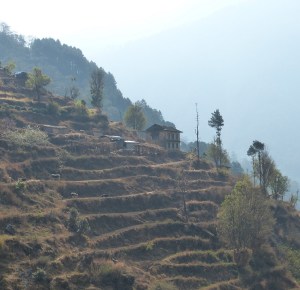
Angtu beams at them, pleased with his story. D&L are riveted and a little bit horrified, and don’t know quite how to respond. No words are needed though. Angtu has another tale.
Angtu: I don’t fully believe, but I don’t not believe either. Once I was ploughing in our village, when I got bad stomach pains. Terrible, unbearable pains. I drank water and tried everything I knew, but nothing worked. So I went to the shaman. The shaman pressed the pulse at my wrist. Then he pressed the centre of my palm. Then he gave me a mouthful of uncooked rice and raw ginger to eat. I was afraid of eating it, but I managed to, and within 20 minutes all the pain had gone.
D: So it worked?
Angtu: Yes, it worked. Lots of cultural and spiritual beliefs were part of my life growing up in the village. A part of the lives of everyone, my friends, my family…. We tried to understand. In our village, the shaman could see a spirit that no-one else could see. A boy with long hair, scary teeth and his feet on backwards. When I was young I would go out at night, on my own, with a light and a little knife, to find this spirit boy. But I never found him.
L: That was very brave! How old were you?
Angtu shrugs.
Angtu: Maybe 10. When we went to school, we would ask our science teacher to explain it to us. We had seen backwards footprints by the river, so the spirit boy must be real. Our teacher would say – maybe they are forwards footprints. He would try to help us see things another way.
L: And now what d’you think?
Angtu: Now I am partly in the Western world, working with tourists for many years. I believe a little of everything. Rai people are mostly Hindu, but we are also connected spiritually to the Earth, the sun and the moon. Shamans help many people. Sherpa Buddhist practices help many people. So I visit the shaman, I take Western medicine, and I pass mani stones and prayer flags to the left. Just in case.
They walk uphill all day. L moves at a good pace, but becomes more and more zoned out as the morning progresses. By lunchtime she is almost, literally, asleep on her feet. They stop at a lodge in the village of Sete.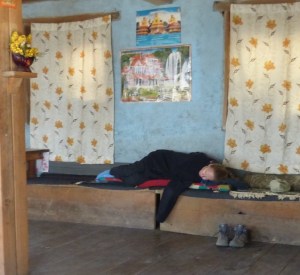
D: Are you hungry?
L: Sleepy.
D: You need to eat. Soup?
L: Porridge.
She lies down on a bench inside the empty dining room and falls promptly asleep. D wakes her up, she eats, and immediately goes soundly back to sleep. D wonders whether the Valium was a step too far. As Angtu prepares to set off again, D nudges L again.
L: I’ve been having the freakiest dreams. About witch-doctors!
D: No. That was real.
The afternoon becomes overcast, and as they get higher, the cloud gets lower. Their destination drifts in and out of the gloom above. L staggers zombie-like, onward and upward.
Goyom is not really a village, but a series of dwellings spreading out along a ridge, each one isolated from the next. Vegetation is sparse, the trunks of trees chopped for firewood stand 2 metres tall, like ghostly figures in the mist.
They are now at 3,200m and it is a great deal colder than it was 1600 metres lower where they started the day. In their room they make a nest of sleeping bags and duvets. On one wall is a dim solar-powered bulb, but the corridor has none. After dark, a journey to the squat loo requires a head-torch.
In the dining room, Angtu has saved them the bench closest to the fire and has been smilingly shooing other trekkers into chillier corners. Their host announces that his wife has gone to a meeting and so there is no-one to make supper as he is a teacher and a businessman, but not a cook. Phurba steps in and competently prepares dal bhat for everyone – as well as working as a porter, he says he’s sometimes an assistant cook too.
***
 Unlike yesterday’s balmier climes, it is 4°C in their bedroom this morning. They poke their noses out of the nest of bedclothes.
L: You smell!
D: Thanks. It’s not me – I’m being dripped on.
They stare at the ceiling where a wet patch is dripping intermittently onto D’s side of the bed.
L: What is it, d’you think?
D: It smells like beer.
Over breakfast, they tell Angtu who in turn tells their host. His wife has returned and Phurba is off kitchen duty.
Angtu: He says it’s cat pee. Definitely not beer.
D: There’s way too much for cat pee. And it smells of beer. Maybe he’s brewing upstairs and one of the bottles burst?
The host looks sheepishly at his wife and shakes his head.
Angtu: Definitely cat pee.
At 3520m, the exposed Lamjura Pass is not a place to linger. From the pass the trail slides between a pinch of rubble and rock to descend steeply and interminably through a tall forest of fir and moss-covered rhododendron trees. L realises that she much prefers uphill to down. They rest every 30 minutes as, despite her walking poles, she starts to stumble.
L: Stop, stop, stop. My legs are jelly.
D: Angtu? We’re stopping. Again.
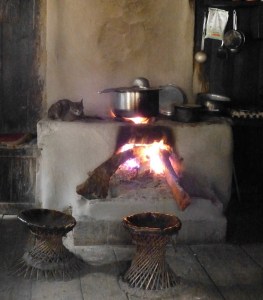 Eventually the terrain flattens and opens into wide alpine meadows with cattle enclosures. At the edge of Taktor they pause at a tea-house. On a wall is a large basket – a doko – full of rhododendron leaves collected from the forest for cattle fodder. Indoors a cat sits on top of the hearth, next to a cauldron of hot water. Their hostess prepares noodle soup – feeding the fire carefully with wood, and removing it again once it has served its purpose – preserving it as a scarce resource.
On the approach to Jumbesi they pass under a vast cliff painted in bright colours with Buddhist mantras. A group of teenagers saunter by, returning from school, in immaculate uniform, laughing and chatting and sharing a packet of sweets. They’d look at home on any high street anywhere, and yet are a world away from the nearest strip of asphalt. At their feet beside the stony path grow clusters of purple primula.
Jumbesi’s houses are large, tidy and prosperous looking. At its centre is a school originally set up by Edmund Hillary. They’ve pre-booked a place that they’ve read about. They pass one after another smart-looking lodges – none of them the right one, and head out to the scruffier far edge of the village. It starts spitting with rain. Their hearts sink.
As a last resort they work their way around the back of the Gompa, the monastery. Ahead is a newly whitewashed building with beautifully carved windows and a row of bright prayer flags festooned along its front. They have arrived. D inspects the rooms with Angtu. L sits listlessly in the foyer – too exhausted to care what it’s like. It starts to pour with rain. D returns.
D: It’s nice.
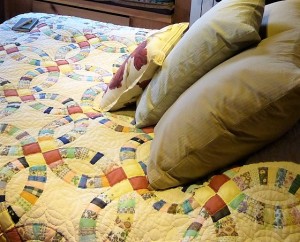
They are shown into a large cosy bedroom of varnished wood, with a double bed. Their hostess points out the electric blanket controls. L almost weeps with joy. It is bliss. They can’t waste a minute of it.
L: The blanket’s on! It’s actually warm! Quick, let’s get into bed.
D: It’s half past two.
L: It’s raining.
D: Oh alright then.


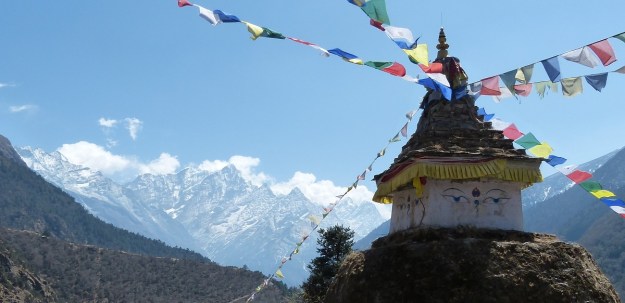
 High above Jumbesi, below the monastery, towers an immaculate white and gold stupa. Four layers of niches wrap around the circumference, and in each little midnight-blue alcove sits a tiny golden Buddha. Prayer flags stream from the pinnacle in all directions. Mani stones, mantra-covered boulders, and prayer wheels mark the onward route.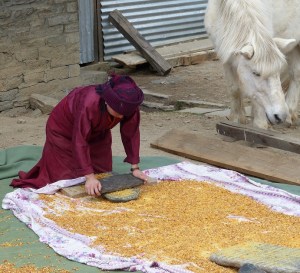
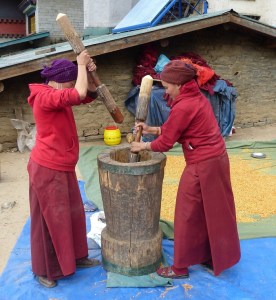 In one courtyard nuns have spread maize kernels on large tarpaulin sheets. One is kneeling, crushing the kernels under a rock, whist a shaggy white pony stands at her shoulder hoping for a meal of husks. At a waist-high wooden pestle and mortar, the maize is further ground by two more nuns, heavy wooden clubs raised and lowered, pummelling rhythmically, wood on wood.
 D: A black dog!
 The following morning they try again.
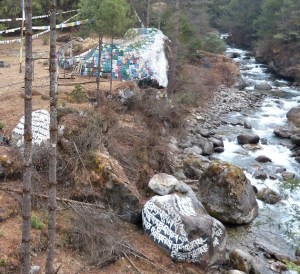 The day is overcast but dry. The landscape is beautiful – a gentle path undulating around meadowy hillsides, through clumps of fir trees, past grazing cattle and (clockwise) around stupas and prayer flag poles. They cross a river on a swaying steel suspension bridge above a group of mani boulders painted in multi-coloured mantras. Despite the mild gradient and the fact that they are still at well under 3000m, L walks slowly, panting like crazy, as though her lungs are battling the thin air of high altitude. She is coughing so much that her chest hurts and her stomach muscles are sore. The three hour walk to Ringmo takes five and the final 200 metre climb finishes her off. She staggers into the first guest house they come across.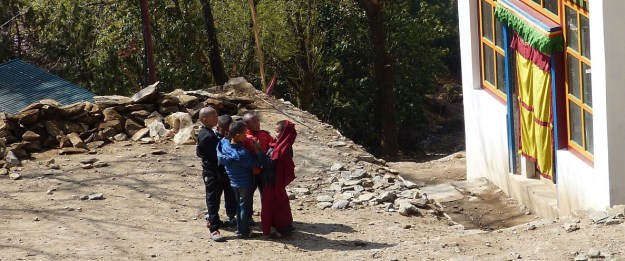
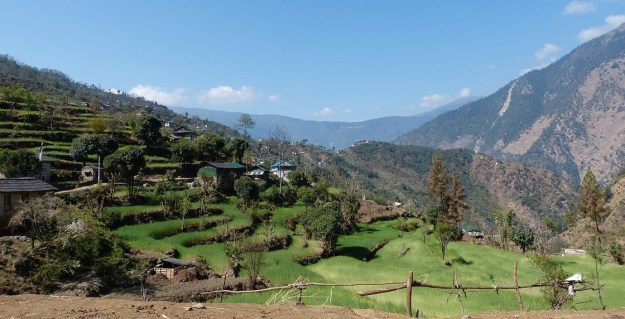
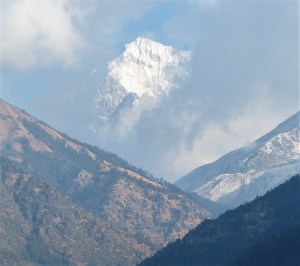 The early morning light drapes the hillside with a chilly blue hue, but the sky above is clear. In the distance a curtain of morning mist opens briefly to reveal an immense white pyramid, and then closes again, as though they imagined it. They climb steep cobbled lanes, past orchards and neatly fenced paddocks, and, still cobbled, still steep, on a sunken lane through woodland. At the top a covered gateway leads them to the Trakshindu La. The 3070m pass is scruffy and windswept – a bare earth farmyard with a lodge, barns and animal enclosures. Contradicting all outward appearances, inside the lodge dining room every table has a pretty cloth and a vase with fresh flowers. Near the door is a huge copper basin filled with water, in which freshly picked marigolds float on the surface. An elderly woman arranges them lovingly. It is entirely unclear where in this harsh landscape these flowers could possibly have come from, or whom they are for.
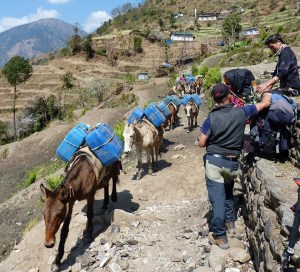
 The trail becomes punishingly steep, a waterfall of dust and boulders. They continue down, glad of knee supports and trekking poles. Below, they can hear, and then see, an icy blue river and a huddle of huts. This river is their first glimpse of the Dudh Kosi – which they will follow for the next two weeks, all the way to its source, where at 4,700 metres it flows from the Ngozumba Glacier through Gokyo’s sacred lakes.
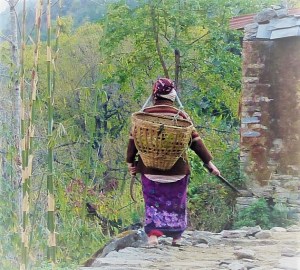 Angtu has been firm again, and in the morning they are on the trail by 7.30am – heading uphill pretty much all day. The landscape is stunning, the sky is blue, and the temperature pleasant. They wish they could dawdle – taking two or even three days to cover the ground instead of just one. Ahead on the path a woman, stick in hand, gracefully flicks cattle dung from the ground into a doko basket on her back. Bamboo, fruit trees and even the occasional palm grow beside the trail. Angtu and Phurba chat and laugh. Phurba sings and quacks like a duck.
 At the top of a steep flight of stone steps they pass through a monastery gateway. There is a choice – more steps to the gompa itself, or a pause for a tea-stop. L opts for tea and basks in the sun. D heads for the steps. At the top, prayer flags flutter and the gompa door is open. Inside, his socks slide on the polished wood floor. The walls and ceiling are alive with colour, shapes and patterns. Layers of fabric forming cylindrical frills, in reds, greens, yellows, blues and white, hang from the ceiling. One wall is made up of niches for prayer books. Two green-skinned drums stand sentinel over low cushioned benches for monk meditation. Outside again, the sunlight is dazzling and the lush green valley is spread out at his feet.
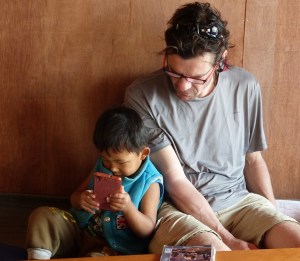 In a tea-house in Bupsa they order noodle soup and omelettes. The owner’s tiny son shares a bench with D, playing a game on his mother’s phone. He edges along the bench, studiously ignoring D. D peers towards the screen and gives advice. The boy takes no notice, loses the game and slides closer to D. They both study the screen. The boy loses the game. He hands D the phone. D loses the game. The boy rolls his eyes and reclaims the phone. He loses the game. The boy gets comfortable, turning sideways, leaning back, using D as a back rest, feet on the bench, phone on his knees. D drinks his tea. The boy loses the game.
 They climb back up the bank and onto the path, still behind the donkeys, and follow them into Paiya. At the entrance to the village there’s another hold-up. A workman has left a hammer on the narrow metal bridge, and there is no way one particular donkey is stepping over that hammer. No way. After some ineffectual shouting and pushing, the hammer is removed and the donkey train continues.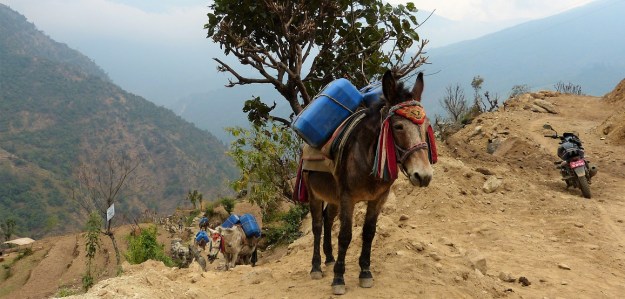
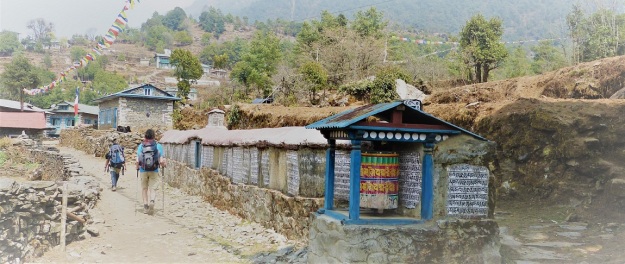
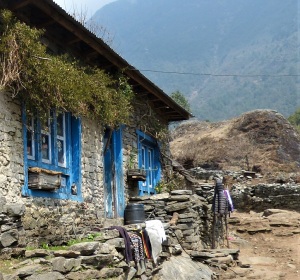 They come to Moshe, a medieval-looking collection of tiny stone cottages and doorways in rock-faces. The land is worked – divided into little stone-walled fields and compounds. There are no shops or lodges or tea-houses. More than anywhere they’ve walked through so far, this place seems utterly untouched by tourism and modernity, separate, forgotten. Lukla’s town and airport are invisible and yet just a few hundred vertical metres above them. They are right in the flight path. Some days 1000 people pass over their heads, but each is oblivious to the other. They are worlds apart.
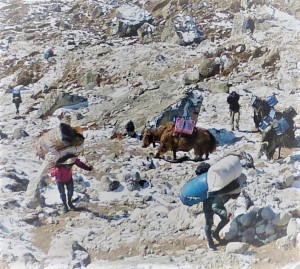 There is also a hybrid third group – the expedition porters. These guys tend to look and dress like trekking porters – young, fit and reasonably well equipped. However, it seems that they too are paid by the kilo as they carry ludicrous loads, the furthest distance, to base camps at the foot of the world’s highest mountains, covering many miles a day. They are doubled over under towers of chairs, rolls of carpet, steel folding tables, mattresses, drums of climbing gear, cooking gas cylinders, pots and pans. It’s seasonal and punishing work, but lucrative if they can get it.
 Angtu acts as translator and go-between, making sure they have everything they need.
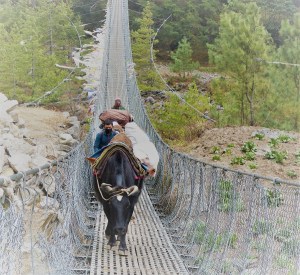 D: Are those yaks?
 L: 3%. Hardly any. And guess how much is barren land over 5,000 metres?
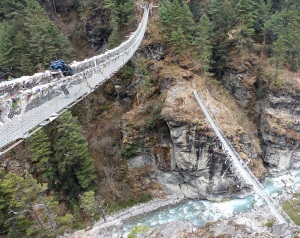 It’s still spitting when they make their way alongside the river bed, on a path of worn-smooth river stones. Ahead across the river are two long suspension bridges, one above the other, reaching from one hillside to the next. The lower one is no longer used. The higher one is a very long way up.
 There’s good news – the hotel is giving Angtu free accommodation and meals.
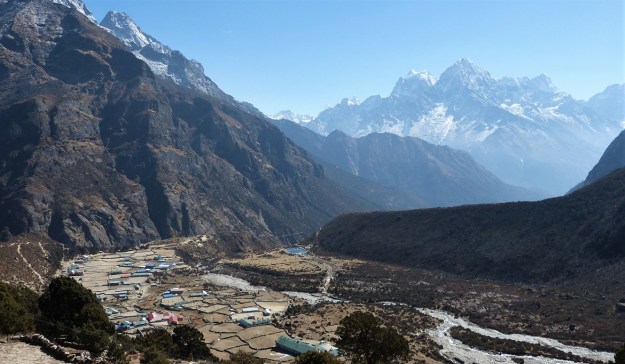

 He takes them up to a viewpoint above town. On the northern horizon, the clouds shift briefly.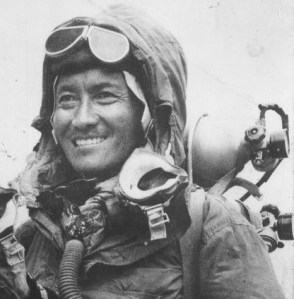

 They cross the yak paddocks in Thame. Yaks are lying or grazing, wearing woven collars and big bells and wisps of crimson wool. On their withers is tied a white prayer-flag with Tibetan script printed in gold.
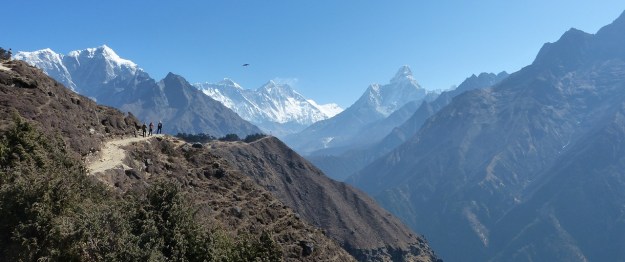
 A crumbling path rises vertically behind Namche Bazaar. Angtu groans loudly at intervals, grinning widely, as they climb 400 metres in under an hour, overtaking a steady stream of panting, less acclimatised trekkers.
 All day they walk towards Ama Dablam pointing haughtily skywards, a backdrop to stupas, prayer-flags and picturesque yaks. It photo-bombs their pictures. It demands to be admired. It’s the most beautiful peak they’ve ever seen.
 Often, pushing trekkers too high too fast is simply down to a battle by tour companies to offer competitive prices and so a tightly timed itinerary. Sometimes though, the reasons are a lot more sinister. There are scams where companies deliberately cause their clients to become ill, with altitude sickness or food poisoning, and then call in a helicopter which delivers the trekker to a private hospital. There are plenty of winners – kickbacks for all – the trekking company and guide, the helicopter company and pilot, and the private hospital. There is also one big loser. The trekker gets a curtailed holiday, a life-threatening illness, a helicopter ride, a stint in hospital, and a gigantic bill.
 Birch and rhododendron woods line the path, moss hanging from tree branches and the river is occasionally visible far far below. Frozen waterfalls and torrents of snow and ice stripe the cliffs overhead and cross the trail, incongruous in the strong sunshine and soft woodland.
 L: And what are the symptoms? Apart from feeling tired and breathless.
 At a lonely teahouse skirted by stone-walled yak paddocks, they stop for tea. The sun gleams off the blue tin roof, the pristine whitewash and the silver dish of a solar kettle.
 At the top of the pass they enter a long valley strewn with boulders. They pass the first of Gokyo’s sacred lakes on which a pair of orange Brahminy ducks glide and preen on the metal-grey water. Further on they reach the second sacred lake. It’s fringed with decorative cairns, placed there by Hindus and Buddhists for whom these lakes have religious significance, or by trekkers taking selfies.
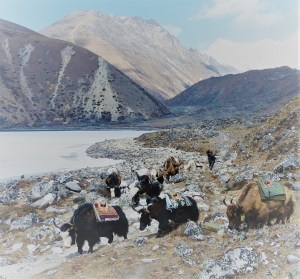 A train of yaks lumbers by, calmly picking their way across the rocky ground, and swinging their big gentle lethal-weapon heads from side to side. Some have untidy white face markings on otherwise black woolly coats, as though they have been apple-dunking in a trough of whitewash.
 In this remotest of backwaters is a cluster of trekking lodges. Their bedroom has a carpet, a lake view and clean linen on the twin beds. The internet works and there is a plug for charging phones. A skylight lets the sun heat the space in the day. They look in wonder at the en-suite bathroom with Western loo, a basin and a shower tray.
 L: (squeaking with excitement and breathlessness) Look at that – it’s enormous!
 D&L scramble and explore and take photos. They ceremoniously secure their tiny string of prayer-flags and imagine the prayers taking flight, like leaves, spinning and drifting across the magnificent scenery, spreading peace and wisdom, compassion and strength onto the world below. Then they just sit. And look. And take it all in.
 The terrain becomes more and more uneven, littered with stone, rocks, boulders. They pass the fourth sacred lake, a blank ice sheet against a barren brown hillside and cloudless cobalt sky.
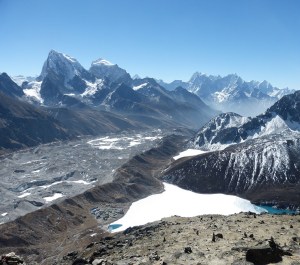
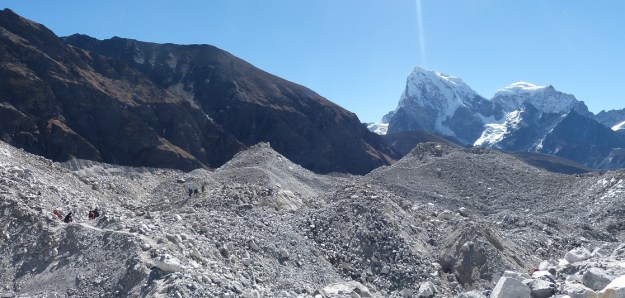
 The glacier is forbidding up close, an apocalyptic moonscape of slow moving rock and ice, and unfathomably huge. From the flank of Cho Oyu it descends in a blue-white ice-fall, turning to stone as it reaches the floor, carving out a great grey gravel lake before creeping southwards along the valley to Gokyo and beyond.
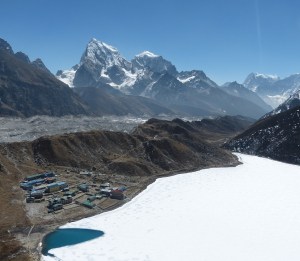 L: It’s the lake!!!
 A brief scramble behind the village brings them once more to the rim of the glacier. Today they’re going in. They look down over the edge. There is a steep slope of loose stone and scree and gravel and dust that they must descend to get into the glacier, in order to cross it. A couple of people are ahead of them, already at the bottom of the slope. They are tiny, ant-like. D&L shake their heads, trying to knock their brains into registering the scale of what they are seeing. There’s a scuffle and a hiss and a puff of dust below. Loose stones are rattling down the slope. D&L start downwards, skidding and sliding. Another flurry of pebbles tumbles across the path ahead.
 They continue, dropping down past the edge of a frozen pool of water. On one side rises a vertical wall of multi-layered ice, festooned with icicles and topped with a carpet of rubble. They stare in fascination at the cross section of glacier. A down-stream path leads them eventually to the foot of the moraine wall on the far side. Their exit is a vertical scramble over loose rock and stones and dust, all crumbling and slipping beneath the soles of their boots, until without warning they suddenly burst over the rim onto a grassy plateau. They are out.

 They set off at 5.40am. From behind Tagnag, a cleft climbs and widens, the shallow stream turning to ice as they gain altitude. Their fingers and toes become numb with cold. L fumbles to unscrew the lid of her water bottle. The cold air rushes in and the water quickly freezes. The temperature registers as minus 7°C. The sun rises and tantalisingly floods the mountainside above them but does not reach the trail. They reach a first pass of grey shale, at 5100m, then drop down into a huge parched-grass valley sprinkled with boulders. The views are magnificent but they remain in deep shade.
 Angtu: It’s better early, like now, before the sun. Later, when the ice melts it can be unstable. Sometimes there are rockfalls.
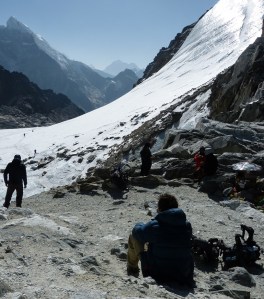 They sit in the sun at 5420m, feeling happy and healthy, and munching yak-cheese chapati sandwiches and Snickers and watching brightly jacketed ant-like figures making their way up the snowfield towards them.
 They take off their crampons and negotiate a narrow rocky snow-covered ledge high on one side of a steep valley wall. They should have kept the spikes on. It is icy and slippery underfoot and the fall would be long and uncomfortable. D watches nervously as ahead Angtu holds L’s hand as she skids and trips and wobbles along the path. Angtu leaves her wedged securely between two boulders while he doubles back to help a pair of independent trekkers also unsteady on their feet.
 On the far side of the valley, they come over a rise and arrive at Dzongla, a small cluster of scruffy corrugated iron farm-like buildings lying in a bleak little bowl. They are tired and hungry but triumphant to have survived despite the dire warnings of ice and falling rocks and crevasses. The lodge is busy but neither clean, warm nor fragrant – its only redeeming feature a beautifully crafted floor-to-ceiling tower of yak-dung in the hallway.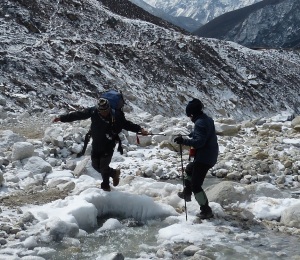
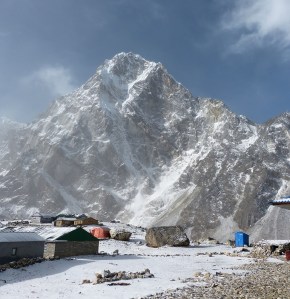 From the warmth of their sleeping bags, at 6.00am, they check the temperature in their bedroom.
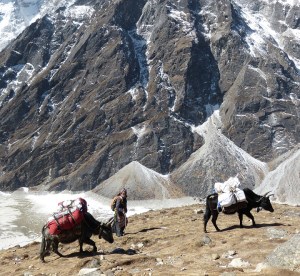 On a meadow-like spur they stop to admire the views. A woman walks past, driving her three yaks. She is wearing a traditional full-length skirt and headscarf and carrying a high-tech trekking backpack. The river meanders down the valley, back towards Lukla. To their left is an immense dam of glacial rubble – the stony front end of the Khumbu Glacier. At its foot, seemingly right in its path, cower the buildings of Dughla. To their right towers the craggy shoulder of Cholatse. Angtu and Phurba strike poses and photograph each other. Then they sit and eat biscuits.
 They turn their back on Cholatse to the west and Ama Dablam to the south, and head north towards perfect peak of Pumori. There are only a very few other people on their path, but below them they can see strings of tiny figures zig-zagging their way slowly up from Dughla, climbing the rough tongue of the glacier. This is the main Everest trekking route, and it’s busy.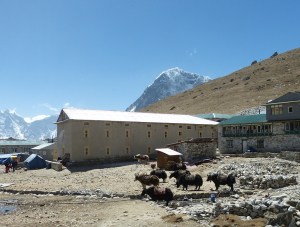

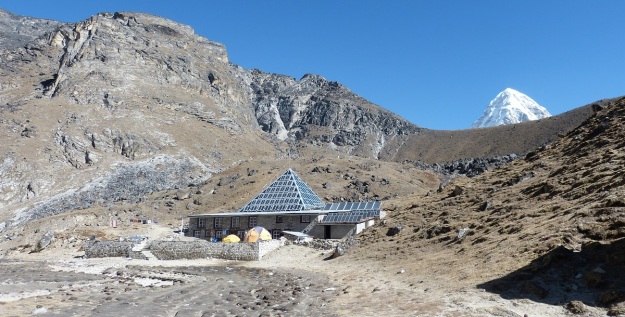
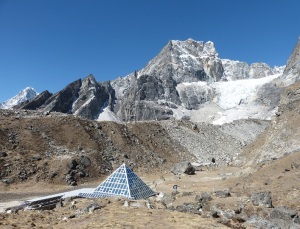 In a little barren side valley a solitary low stone lodge is half buried into the hillside and topped by a large glass pyramid sheathed in solar panels. Behind, in a perfect mirror image, rises the white peak of Pumori, and opposite, a glacier tumbles straight down the mountain into the valley. A few dumb-bells and makeshift gym equipment sit on a low wall. They are definitely in the right place.
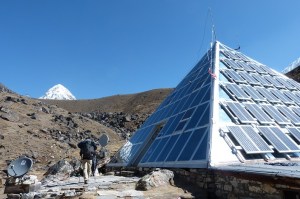 Kaji: We also collect geological seismic data – any earthquake activity.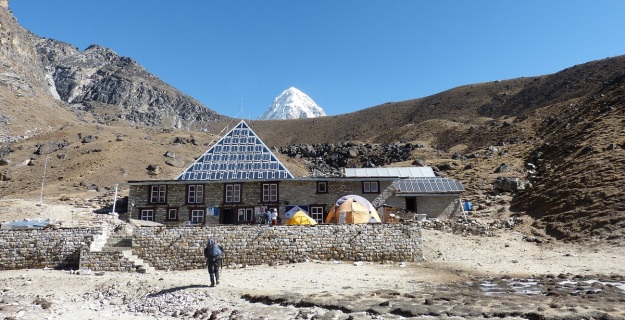
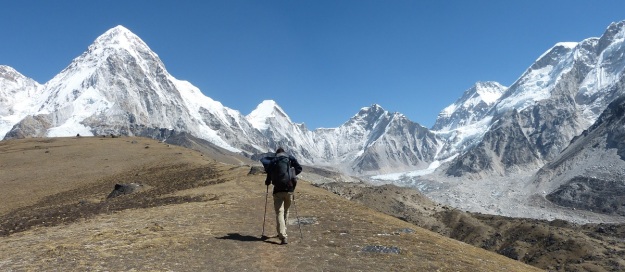
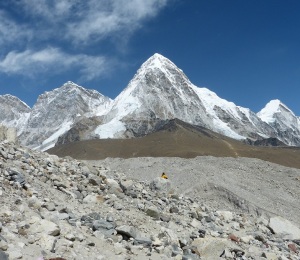 The bliss ends abruptly as their route converges with the main path at a junction of two glaciers. The meeting point is a monumental mess of rubble and rocks and boulders. It’s less than a kilometre across the glacier to Gorak Shep on the far side, but it takes them an hour. The dusty, stony trail weaves and undulates through the maze. Every step is uneven, the ground loose, and dust rises to coat their faces. New paths are forged as old ones fall away, crushed by slabs of dirty grey ice and dragged underground by slow-moving debris.
 They climb the hill, checking their altimeter, breathing heavily but otherwise comfortable, and stop once they’ve reached 100m. From here they can see the Porters’ Lodge. It is set apart from the other buildings – a long low corrugated-iron barn with no windows, but skylights in the roof. It looks a lot like a cow shed.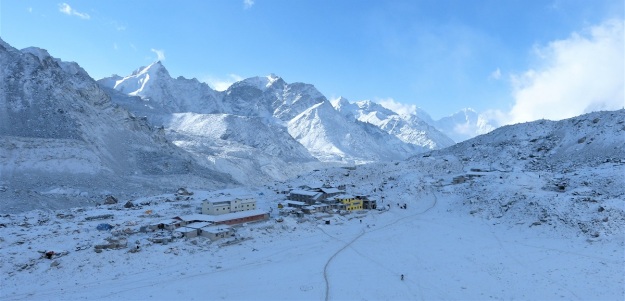
 And Then They Went