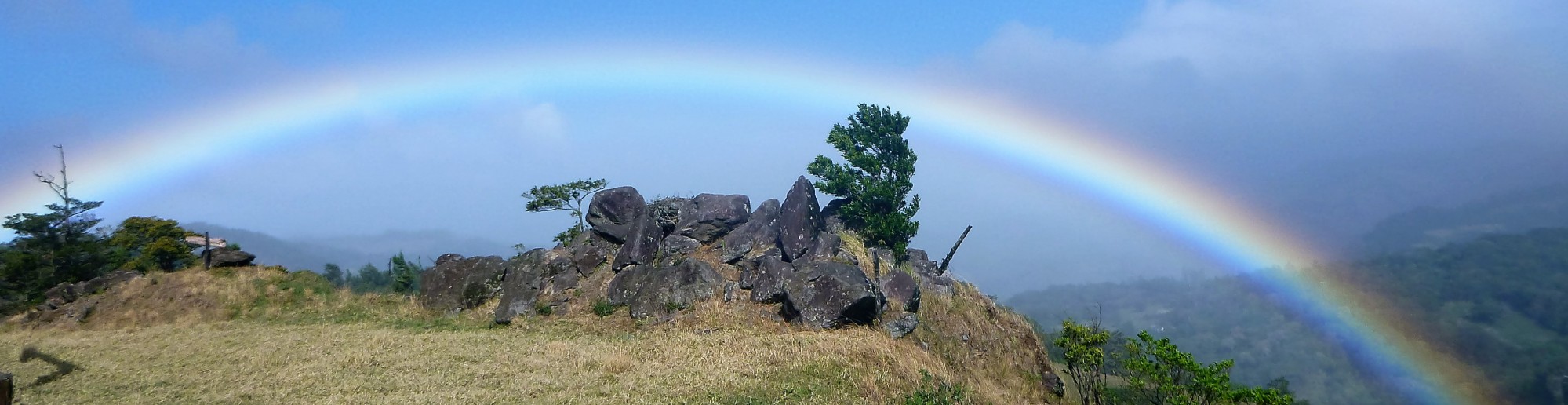
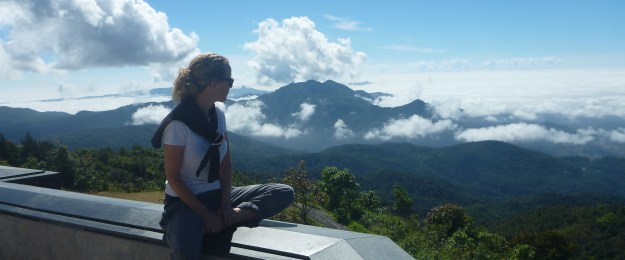
D&L have a craving. They need to get high.
At 2565 metres, Doi Inthanon is Thailand’s tallest mountain, and has a road leading right to the top. Its wooded flanks form a National Park with some impressive waterfalls and good swimming spots along the way.  Near the summit are a pair of modern temples set amongst immaculately tended gardens and dedicated to the King and Queen. It is popular with locals, and on a sunny Saturday there are lots of visitors, flocking here from Chiang Mai to enjoy the views and the cool air. At the top it is a mere 17 degrees, and Thais are bundled up in thick jackets, scarves and hats.
They follow a concrete path a short distance from the car park to a large wooden sign proclaiming that they have arrived at the Highest Spot in Thailand.
L: Quick, take a photo.
D: This is all wrong. I’m not happy.
L: What’s the matter?
D: We’re not properly at the top. The slope carries on rising behind the sign. And the path goes up two steps just over there!
He stomps off, unconvinced, and stops 50 metres further on, at a wooden walkway from which the ground drops slightly in all directions. He nods seriously, satisfied.
D: THIS is the Highest Spot in Thailand. Take a photo.
***
 They drive north, to Chiang Dao, searching for a “proper” mountain. One without a car park on top. Chiang Dao’s mountain, Doi Luang, is rocky and steep with great scenery and varied vegetation. At 2175 metres it is Thailand’s third highest summit, and apparently the country’s best mountain hike. Most people do it in two days, camping for a night just below the summit. But there is only a small weather window – one day of sunshine – before the rains promise to return.
L: Can we really do it all in one day?
D: 1100 metres up, and the same down again. 15 kilometres. Piece of cake. As long as we start early.
L: But I’ve hardly done more than climb the stairs in a year. What if I don’t make it?
D: You’ll make it.
L: You can’t just leave me behind on the mountain. There are tigers. And cobras.
D: Really, you’ll make it.
They arrive in the village late afternoon, and head to the park office to get their permits. They find the office open, and walk in.
Woman: We’re closed.
D: But can we just….
Woman: We’re closed. Come back tomorrow. 8 o’clock.
L: (muttering) So much for starting early. I’ll never make it. We’ll be benighted. With the tigers.
D: Don’t worry, I know where the walk starts. We’ll take a quick look this evening and see if we can get in on our own. If so, we can start really early tomorrow.
They drive to the edge of the village. From here a small road winds up to a pass at 1100 metres. The walk starts from the pass, while the road continues down into the next valley and beyond, towards the Myanmar border. They are stopped by a park guard at a road barrier. Local through traffic is waved on, tourists heading up the mountain are not.
Guard: Where are you going?
D: (who can’t tell lies) Just…..on…..
The guard takes a close look at them. They are clearly going up and not passing through.
Guard: It’s closed.
D: But the road….?
Guard: Go back to the park office. Tomorrow 8 o’clock.
L: (muttering) Benighted. With the cobras.
***
 They return to their room, appropriately known as The Nest. Their little bamboo cabin is tucked into the undergrowth at the far corner of a lush garden. It is charming and smells of damp straw.
D: We’re sleeping in a basket.
As darkness falls, the crickets start up, and the soaring outline of the mountain stands silhouetted against an indigo sky. It is very peaceful and utterly beautiful. They head to the Nest’s excellent restaurant for dinner and order Thai red curry.
Waitress: Mild, farang (foreigner), or hot?
The couple behind them have just confidently ordered a farang-strength dish but they err on the side of caution and opt for mild. It arrives. They tuck in. It is delicious. But sweat beads on their foreheads. Chilli sears their mouths and throats. Their noses start to run.
D: My eyes! Even my eyes are burning.
***
The following morning at the park office they spot another couple of about their age. They have a day pack. The woman is wearing sandals.
D: Ha ha! She can’t be walking up the mountain in those!
L: Don’t be silly. She’ll change in a minute.
While L fills in a form, D practices his social skills.
D: Ha ha! Great walking shoes!
The woman smiles at him frostily and continues her conversation in Dutch.
They explain to the park official that they want to do the walk in one day.
D: And we don’t need the transport up to the pass. We have our own car.
Official: You must have the transport.
D: And we don’t need a guide.
Official: You must have a guide.
Everyone stands there, looking a bit cross. The Dutch couple look at their watches. They already have their paperwork, having booked and paid the day before.
Official: You can go with them. They have a guide.
It is clear that no-one is delighted by this arrangement. The Dutch pair are not expecting to join other people. However what they all have in common is that they want to get started. D quickly gives them half of the guide and transport fees and everyone cheers up.
L: I expect they’re worried about being stranded up there after dark too. With the tigers and the cobras.
D: I’m sure they are.
Chai arrives and introduces himself as their guide. He bundles the four of them into the open back of an SUV and they head off up to the pass. The woman is still wearing sandals, the thin straps decorated with little sparkly studs. She sees L staring.
Woman: (defensively) They’re walking sandals.
At the pass, L & D carefully adjust their telescopic walking poles. Chai offers a bamboo stick to the other two, and sets off at a quick march. Louie and Sandals charge after him. To her dismay, despite her sensible footwear, L can hardly keep up. Fortunately they soon reach a long, steep, muddy climb, and Sandals adjusts her speed.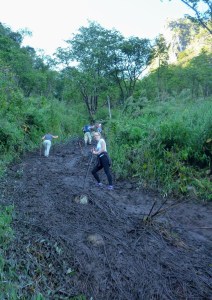
Sandals: I’m sorry I’m so slow.
She picks her way sure-footedly up the incline in her crisp cream chinos, golden drop earrings swinging.
L: (red faced and puffing) Thank goodness – I can’t walk any faster!
A kilometre or so later, the steep mud gives way to a lush valley undulating gently upwards, with thickly forested slopes and rocky cliffs rising to each side. They pass through swathes of elephant grass towering over their heads, an abandoned banana grove, a forest of giant bamboo, patches of jungle, clearings and around great moss-covered limestone boulders. They feel as though they have been shrunk to the size of insects as they make their way through the ever-changing super-sized scenery.
They are the first hikers heading up that day, ahead of any others, but are soon overtaken by porters skipping up the mountain in flip-flops, bent double under enormous weights of drinking water and food for those planning to camp. They encounter 30-40 hikers coming down, in dribs and drabs, all of them young Thais, and none accompanied by guides.
Chai is also wearing flip-flops.
Chai: Easier than shoes.
L: Yes, but you’re a mountain man!
Chai: Yes – a mountain man! But only sometimes.
 As his wiry frame treads nimbly up the uneven path he tells them that he only guides hikes when he can be spared from his father’s farm. The two of them work the land entirely by hand, except for ploughing, producing 5 crops a year – 2 of rice and 3 of carrots and cauliflower. They sell their produce not only locally but also in Chiang Mai and sometimes even in Bangkok.
L: So, really, you’re a farmer.
Chai: (scowling) No, no, I don’t like farming.
L: Oh.
Chai spreads his arms wide and grins hugely.
Chai: I’m a fisherman! Freedom!
He explains that his real love is line-fishing and the sea. During the hot season, he heads down to Krabi where he has a traditional longtail boat, and goes to sea alone for several days at a time. He says he once caught a 72kg fish which he sold for 60,000 bhat. L works it out. GBP £1,500 goes a long way in this part of the world.
Below the summit they arrive at a sloping open area of tall coarse grass, where tents have been pitched for the season on the flattest patches across the hillside. They stop for lunch and Chai unrolls a bamboo mat for them all to sit on. They gratefully take off their shoes and dig out their packaged snacks while Chai unwraps slices of black pudding, and tasty-looking pieces of cooked chicken, pork and beef, which he scoops up in lettuce leaves and eats with his fingers. L frets silently because Sandals is sitting with her bare feet, which are now understandably pretty grubby, pointing at Chai and his lunch. L has read that this is disrespectful in Thai culture and checks that her own, and D’s, feet are suitably positioned not to cause offence. She fidgets and tries to share her concerns with D, telepathically, with the aid of facial expressions and blinking.
L: ……!
D:……?
L:……..!!!
D:…….? Have you got hiccups? Here. Drink some water.
L:……..!
Chai seems to take no notice and munches happily.
After lunch, there is a final half hour to the top – a steep rocky scramble. Louie gets summit fever and charges ahead. Eventually they join him.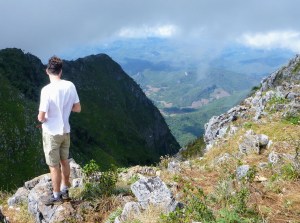
Louie: Great, isn’t it?
The top is enveloped in cloud.
D: Great!
Sandals: Super!
L: (muttering) Why are we all pretending? We’ve struggled all the way up here and can’t see a thing!
D: (muttering) Just smile. Don’t spoil it. Be nice.
Sandals: And we are so lucky to have the place to ourselves!
L: (muttering) Hardly surprising – there’s nothing….oww!
D has inadvertently stepped on her foot. And apparently not noticed. He remains standing on it. Quite firmly.
They stay up there for half an hour or so, Chai dozing, three of them relaxing and chatting, and L darting from one side of the summit to the other, trying in vain to capture brief tantalising glimpses of long reaching views and valleys far below, as the cloud around them swirls and shifts.
On their descent, they pass clumps of cheerful Thai youth coming up to camp overnight. Then they come across a Thai boy aged about 20, sitting on a rock, all alone, with one bare bandaged foot and a pale face tense with pain. Chai stops to speak to him. They learn that he has re-twisted an existing injury and that his friends have all carried on up to the camp.
He begins to weep silently. He has however had a fortunate encounter. Louie is a physiotherapist and crouches down to examine the foot. D is carrying a first aid kit – undoubtedly the only one on the mountain – and dispenses an elastic bandage and anti-inflammatory painkillers. Louie gently and expertly bandages the foot. They all inspect his handiwork, and watch as the toes turn blue.
L: Err…. is that normal?
Louie speaks firmly to the boy.
Louie: It’s only for walking. When you get up to the camp, take all the bandages off and elevate your foot. And rest.
They reluctantly leave him to hobble painfully upwards, while they head on down. L is furious.
L: Well, it’s clear that only farangs are made to pay for a guide for this walk. I don’t care about that. I’m glad we’ve got a guide. But seeing as that poor boy doesn’t have one, I can’t believe his friends left him there, all on his own!
D: You’ve gone all shouty. And squeaky.
L: Sorry.
Chai shrugs his shoulders dismissively.
Chai: Bangkok. They come from Bangkok. That’s what they’re like.
He tells them he was once in Bangkok, and hungry, with only 25 bhat (GBP £0.70) in his pocket. All the street meals cost 30 bhat. He asked time and again at the food stalls if he could buy a meal for 25 bhat – a smaller portion, or without the meat perhaps, but was turned away.
Chai: No! They all said no. In Chiang Mai, if you are hungry or others are hungry, you share food and make new friends!
The last kilometre back down the steep slippery mud slope is hard work and very slow. Sandals skids and sits down. D does the same. Louie gets base fever and strides ahead. They find him lounging in the back of the SUV, dreaming of beer. On the drive home, all congratulations go to Sandals and her sandals, for a remarkable achievement. She looks quietly pleased and admits she’s probably walked quite far enough for one day.
***
The following morning the rain sets in before breakfast. The mountain disappears into cloud and curtains of water pour off the roof of their little basket cabin. They snuggle down in bed, grateful not to be in a tent up the hill.
Deep inside the mountain, and accessed from the village, they visit Chiang Dao Cave. Inside it is warm and dry. A series of Buddha shrines mark their progress as they wander through the tunnels. Branching off the lit route are numerous dark passages. There are signs warning people not to explore on their own in case they never make it back out. D is tempted. L is not.
Sitting next to a golden Buddha they come across a tiny woman clutching a gas lantern. With hand signals she offers to guide them, and gestures into an ominous-looking black tunnel. D is keen. L is not. 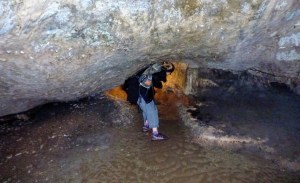 She lights the lamp and dives into the dark. They follow the glow of the lantern into a series of huge caverns and past weird-shaped rock formations, punctuated with her little cries of “slippery!” and “watch your head!”. Every cavern seemingly has multiple tunnels leading to and from it. It’s a real maze. They come to a halt and she waves her lantern at a small hole in the wall, less than a metre square. She smiles. L smiles back and shares the joke, agreeing.
L: Ha ha! No – I don’t think we want to go through there!
D: Actually, I think we’re going through there.
L: Oh.
The tiny guide is half D’s size, tucks herself neatly into the hole and disappears out of sight. With the lantern. D & L stand in the cavern which is now getting rather dark.
L: Crap! Well, follow her then! Or we’ll never find our way out. We’ll just stumble around in the dark till we die.
D: But I’m not even sure I’ll fit. Here – take the day pack.
He passes the rucksack to L and squeezes into the hole. L follows, hot on his heels. They wriggle through several tight spaces, folding themselves double and sideways, until they are reunited with the lantern and its owner in a larger open cavern, grinning from ear to ear from their mini-adventure. The journey continues through several more caverns and down a steep set of steps before rejoining an electric-lit tunnel, where they are free to wander once more on their own. They discover further shrines and admire stalactites lit in pink and blue.
L: That’s better. I think I like my caves nicely lit in multi-colours.
D: How can you say that! Dark is best.
They pass more black apertures and more signs warning of the dire dangers of exploring the unlit tunnels independently. L points at a dark hole in the wall, the size of dustbin-lid.
L: Be my guest. I’ll just wait here. No really. Please. Off you go. I don’t mind. Follow your heart. Dark is best.
D: Thanks. Maybe tomorrow. Shut up.


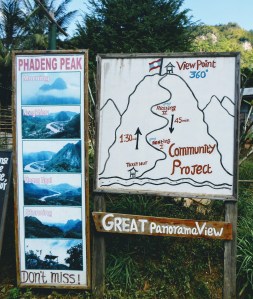 L: I’ve been reading the signs.
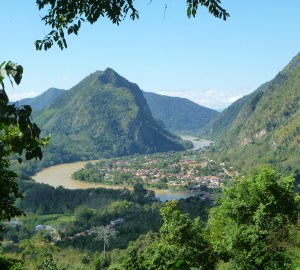 They arrive in Nong Khiaw the previous day, after a four hour minibus ride on quiet, mostly good roads sprinkled with a few potholes of the size that you drive into, and then out of again. The little village straddles the Nam Ou River and the scenery is so magnificent that they just want to choke and fall over.
 D: I think I can bear it.
 The narrow path climbs steeply through the forest, ducking under madly spiralling vines. They manage not to step on any bombs. At the top, they are in thick cloud, swirling around them. There is nothing whatsoever to see.
 D: Officially?
 D: OK. But who dropped all the bombs on Laos?
 The sun is melting the white layers into wisps to reveal the vivid blue sky behind. The signs were right – they have 360 degree views of the most bombed, and surely one of the most beautiful, countries in the world. There is space all around them, into which they feel they could fly. On every horizon lush green mountain ridges jut and soar, cut through by fertile valleys, rice paddies, and the lazy curves of the coffee-coloured Nam Ou River, laid out below their feet.
 D: We’re here. Tham Pha Thok.
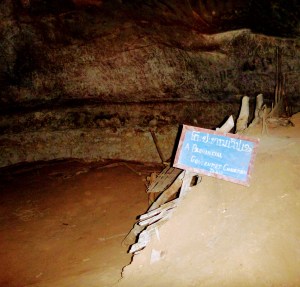 L: This was lived in by villagers, and also by a lot of the provincial government, during all those years of bombing. You can almost imagine it, can’t you? It’s a good safe spot – completely invisible from the outside, and close to a stream.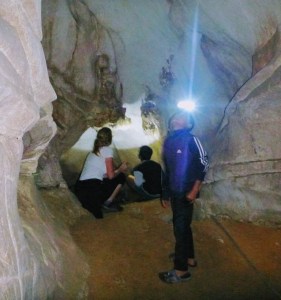

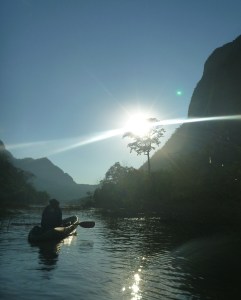
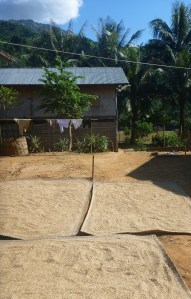 Big: See? This village too, has got electricity now. Just last year. Like my village.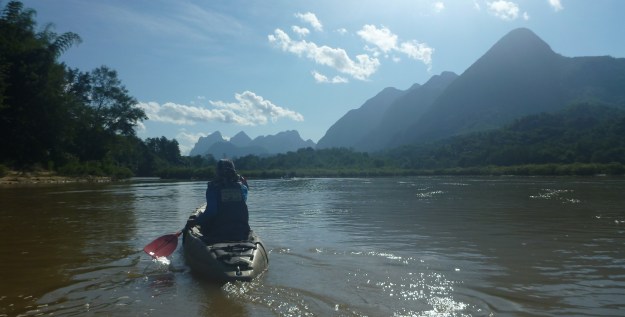

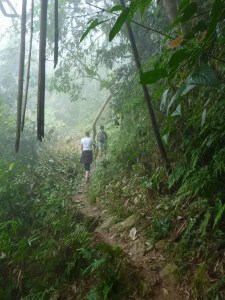 They hear voices above them in the forest. They are climbing steeply through the trees on a narrow path and the cloud has rolled in leaving everything blurred and dripping. Lia stops talking and listens. A dog barks.
 D: So who are they?
 The ridge flattens and they emerge onto an orange dirt road. They are now above the cloud, in bright sunshine under a vivid blue sky.
 The village spreads up both sides of the pass. Single room dwellings of wood and bamboo and palm thatch contain fourteen families and a menagerie of livestock. About half of the houses have corrugated tin roofs but all other building materials have come straight from the forest. They head to the far upper edge of the village, and stop.
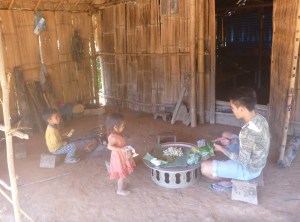 They enter their new home. Under a covered porch two small children sit on tiny stools around a fire in the middle of the earth floor. Nevin is five, but tiny, and his sister Ladah is two. L & D greet their mother, who is their host. She nods shyly at them.
 Their house has a spotlessly swept earth floor, split-bamboo walls and a palm thatch roof. It is cool and airy. A raised bamboo platform covers two sides. This is where they will sleep. L lies back. Despite the absence of a mattress it is surprisingly comfortable. Through the paper-thin wall a cockerel crows loudly. It is roosting under the eaves of their hut. Dangling from the ceiling they notice, to their surprise, a lightbulb.
 The views are glorious – wooded peaks, patchworks of upland meadows and a sea of cloud blanketing them from the rest of the world below. In the fold of a valley lies another little village, spreading down the slope like a landslip. The boys spot figures on the opposite hillside, as tiny as beetles, maybe 500 metres away as the crow flies. They call across and a long conversation ensues, phrases floating to and fro, bouncing from one hill to another, as natural as a phone call, with no need for technology.
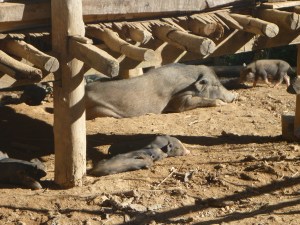 D: Well, for a start, with no shops there’s no packaging. Or carrier bags. That helps.
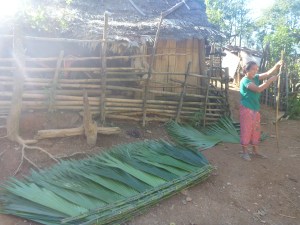 A woman is weaving palm leaves to make sections of roof. She laughs and blushes with pleasure as they admire her work. Another woman and her daughters return from the fields with baskets bulging with marrows.
 On the hillside behind their hut, beyond the edge of the village, is a large flat clearing. From here, they have an awesome 180 degree panorama of peaks spread out at their feet and of the sun sinking behind the mountains, washing their own hilltop in gold. It is blissfully peaceful and utterly stunning. They stand there gawping and wearing out their camera. There is a chuckle.
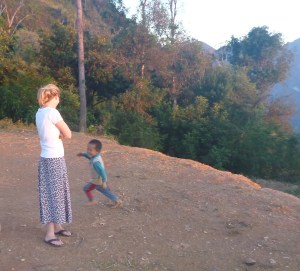 They run circles around her, chanting and laughing. L laughs with them, whirling within their circle but keeping her distance, frightened of frightening them.
 They sit around the fire in the dark. Puppies and hens tiptoe close to the embers. Lia brings out supper. There is barbecued chicken, boiled marrow, chicken and marrow soup, and rice.


 L: Does everyone get their drinking water from the lake?
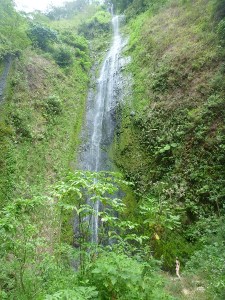 Just around the next corner they arrive. The San Ramon Waterfall cascades down the mountain from 40 metres above, ending in a shallow pool. It is so tall and so sheer that they have to tilt their heads backwards, further and further, necks cricking, just to see the top. Moss and tiny ferns line the cliff wall and wet rock glistens in the sunlight. They have the place entirely to themselves, like one big awesome secret. They stand under the waterfall happily, wade in the pool and admire. They sit on a rock, drying off and eating biscuits. Soon a woman arrives with her son, aged about ten. The secret’s out. It’s time to leave.
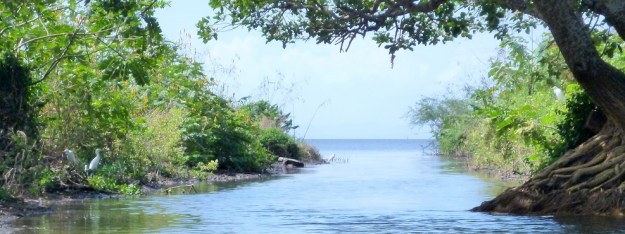
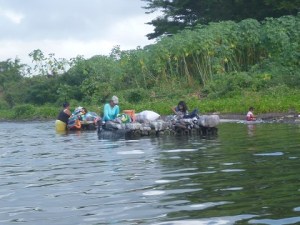 They are kayaking along the lakeshore. Women stand in the shallows doing their laundry on rock platforms built for the purpose. Toddlers play on the shore. A fisherman sits on the gunwale of his boat, mending nets. From time to time a rustic wooden dwelling is visible amongst a clump of palm trees at the water’s edge. But mostly the shore is given over to forest and pastures. They spot herons, kingfishers, egrets and ospreys.
 Guide: Look, a great egret, and next to him a great blue heron.
 L: Take a photo!
 Guide: On the bank. Black necked stilt birds.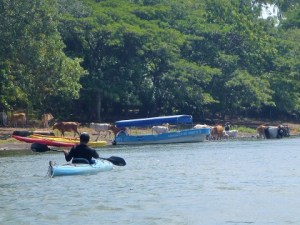

 And Then They Went