Lobuche (4910m) – Italian Pyramid (4970m)
Date = 28 March
L: So?
D: Minus 5°C.
The cold is getting colder. D&L are snug in their bedroom with sleeping bag and duvet and thermal clothing. They need to cover their heads at night, wearing hats and pulling sleeping bags tight around their faces. In the mornings, the inside of their window is coated with ice. The air temperature in their room makes the water in their water bottle freeze when they open it to clean their teeth. The loo cistern freezes overnight. Even to flush the loo from a bucket they need first to break the ice in the bucket.
They slurp milky porridge soup at 8am while the lodge cleans around them. All the other trekkers left hours ago. Angtu shrugs at the staff. He’s been trying for weeks to get L&D to set off early like everyone else, with very little success.
Half an hour up the valley they stop at a sign saying “8000 Inn” and pointing off the main trail.
Angtu: Is this the turn? Is it a hotel?
They are looking for the Italian Pyramid. Angtu has never been there. His clients have always been in too much of a rush to get to Everest Base Camp.
L: I don’t think so. It’s supposed to be a research centre.
D: It says it’s just 5 minutes. Why don’t we go and have a look anyway?
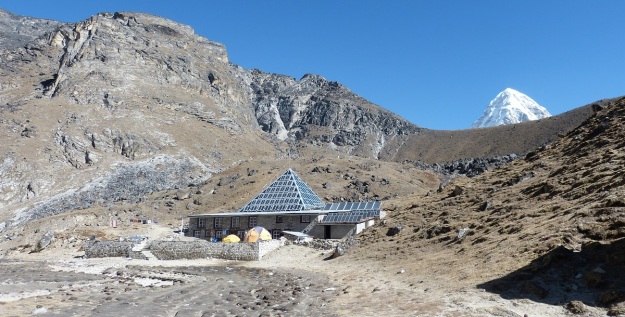
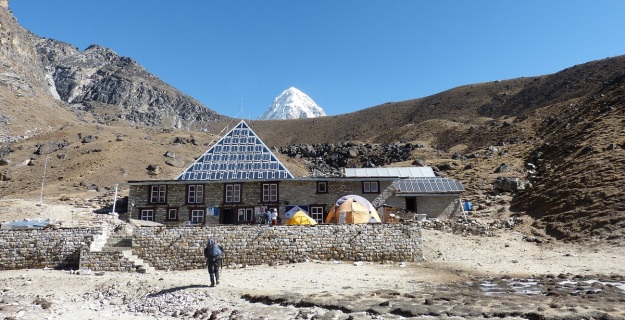
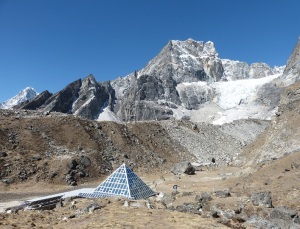 In a little barren side valley a solitary low stone lodge is half buried into the hillside and topped by a large glass pyramid sheathed in solar panels. Behind, in a perfect mirror image, rises the white peak of Pumori, and opposite, a glacier tumbles straight down the mountain into the valley. A few dumb-bells and makeshift gym equipment sit on a low wall. They are definitely in the right place.
The catchily named Pyramid International Laboratory/Observatory High Altitude Scientific Research Centre was built in 1990 by a pair of Italians – a mountaineer and a geologist – to measure the exact height of Everest and K2. It has been used for scientific research ever since, and is commonly known as the Italian Pyramid.
They are met by the softly spoken manager who speaks very good English and looks very Italian, with fashionably shaved scalp, designer stubble and blue eyes in a deeply tanned face. After weeks of being immersed in incomprehensible Nepali, L&D prepare to break into a language they can actually speak.
L: Hello! Are you Italian?
Kaji: No, I’m Nepali.
L: Oh.
Kaji Bista welcomes them, makes them tea, settles them in front of a huge TV showing a cricket match, rustles up a plate of egg & chips for another visitor, and then shows them around.
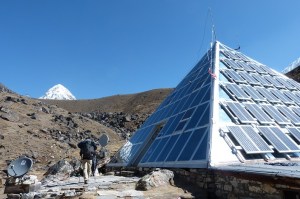
Inside the pyramid a number of small rooms are crammed with scientific equipment, paper files and work spaces. In one room a large yellow body bag lies on a table. Stairs climb to an upper floor and a ladder to a space in the pyramid’s peak. The glass is not glass – it is flexible Perspex. The whole building flexed comfortably during the 2015 earthquake, remaining undamaged and protecting the equipment within. There are Italian electronics labels and stickers everywhere.
L: Look – it’s just like being at home! We’re English, but we love Italy! We live there half the year.
A look passes fleetingly across Kaji’s face, like a twinge of sudden toothache. He says nothing. Having clearly hit stony ground, D changes the subject.
D: So what exactly do you do here?
Kaji: We collect meteorological data, about the weather, from here and also from Namche Bazaar. And from the top of Kala Pattar. Have you been there?
D: Next week.
Kaji: You’ll see our weather mast up there. Webcam too.
He walks to a monitor and clicks his way to live weather info and an image. It looks cold.
 Kaji: We also collect geological seismic data – any earthquake activity.
L: Including the earthquakes in 2015?
Kaji: Oh yes.
He waves at an information poster.
Kaji: We gather climate change data on nearby glaciers – how fast they’re retreating. Every month I go back to see what’s changed.
L: And the gym equipment?
Kaji: Yes, we get physiological data from people – on how they are affected by altitude.
D: And what happens to all the data?
Kaji: It’s sent back to Italy. All the data can be accessed and transmitted remotely. Even the lights here can be controlled from Italy!
The whole place is astonishingly high-tech for somewhere so very remote.
L: And the yellow bag – is that a decompression chamber?
Kaji: Yes – we have a portable hyperbaric pressure chamber and oxygen. This month we’ve treated 7 people. But the lodges and trekking companies don’t like to bring people. We don’t charge, so no-one makes any money from it.
L: And now you’ve opened the place up as a lodge for trekkers too?
Kaji frowns.
Kaji: I had to. I’ve not been paid a salary for 3 ½ years.
L: Sorry – what did you say?!?
He gently explains. The Italian government stopped funding the centre without warning. His Italian boss in Bergamo took the government to court, and won, but still no money has arrived.
L: (thinking to herself) Me and my big mouth. That explains the tooth-ache face.
D: (thinking to himself) L and her big mouth. “Oooh we love Italy!”
Kaji: We used to be a team of 14 people. Now I am the only one still here. I collect all the data myself. If I left, the research station would close. So now I use the empty accommodation as a trekking lodge. To bring in some income. Sometimes scientists visit too.
The lodge is cosy, the rooms thickly insulated. The enviable bathrooms are tiny gleaming white plastic pods straight from an Italian motel. D finds a tip-box and discreetly feeds it, attempting to compensate for the behaviour of his adopted country and his wife.
L: Is there nothing you can do?
Kaji: I hope the new Italian government will free up some funds.
L: Couldn’t someone else take it over?
Kaji: Maybe, yes, we could sell our data to richer countries such as China, but until now it has always been Italian. For 29 years. It would be nice if it could stay that way.
L: How long have you been here?
Kaji: Eleven years.
L: And does your family come to visit you?
Kaji smiles and shakes his head.
Kaji: No. It is too far. Takes too long. I have four children studying hard in school and college and I go to see my wife twice a year.
They leave Kaji living alone in his valley at 5000m, gathering data from glaciers and mountaintops, running a research lab and a trekking lodge, and saving lives on the side, working for no pay for a far-away country which has forgotten him.
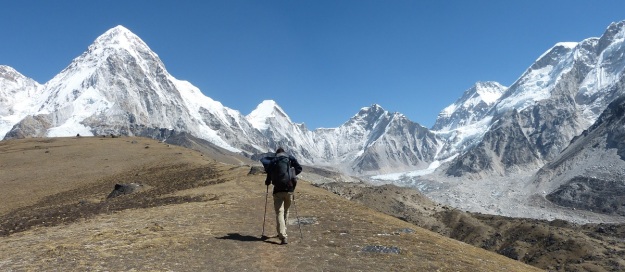
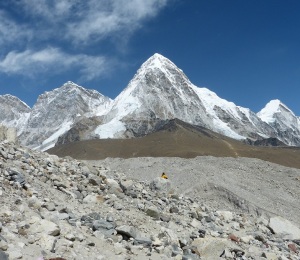 The bliss ends abruptly as their route converges with the main path at a junction of two glaciers. The meeting point is a monumental mess of rubble and rocks and boulders. It’s less than a kilometre across the glacier to Gorak Shep on the far side, but it takes them an hour. The dusty, stony trail weaves and undulates through the maze. Every step is uneven, the ground loose, and dust rises to coat their faces. New paths are forged as old ones fall away, crushed by slabs of dirty grey ice and dragged underground by slow-moving debris.
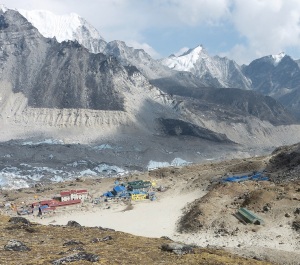 They climb the hill, checking their altimeter, breathing heavily but otherwise comfortable, and stop once they’ve reached 100m. From here they can see the Porters’ Lodge. It is set apart from the other buildings – a long low corrugated-iron barn with no windows, but skylights in the roof. It looks a lot like a cow shed.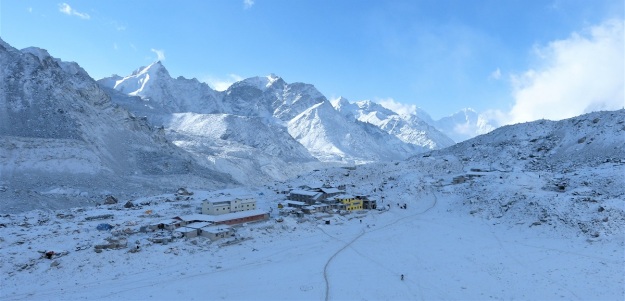
 Gorak Shep (5160m) – Everest Base Camp (5364m) – Gorak Shep (5160m)
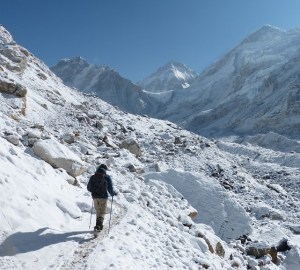 Instead of starting from Gorak Shep, most guided groups walk for 3 hours from Lobuche, pausing for an early lunch in Gorak Shep before arriving at Everest Base Camp in the early afternoon, and then heading back to Gorak Shep for the night. It saves a day, keeps costs down and reduces the time spent at over 5000m.
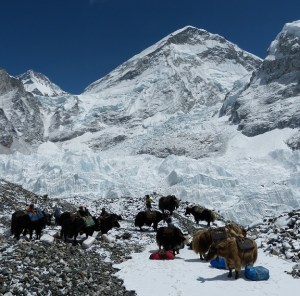 They descend onto the Khumbu glacier at around 10am – the landscape a heavy rolling sea of snow-sprinkled rock-strewn peaks and troughs. Ahead a train of yaks weaves its way calmly through the chaos. The path leads them to a small hillock strewn with prayer flags. They are approached by a tall bearded man speaking heavy accented English with some difficulty. D&L they recognise the accent and switch helpfully into Italian.
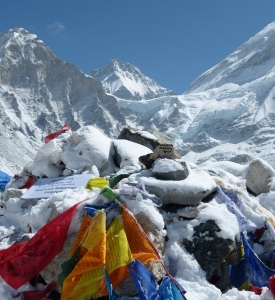 They grin at each other stupidly in disbelief. Angtu returns and leads them over to the pile of stones and prayer flags, where he has dusted the snow off a couple of small rocks on which people have written EBC and the date, in crayon. It’s good enough for the Italian. He gets out his camera phone and then delves once more into his rucksack, bringing out a fist-sized rock on which is written “Majella – Abruzzo – Italy”
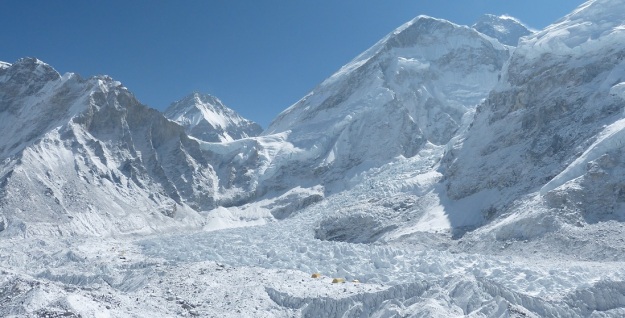
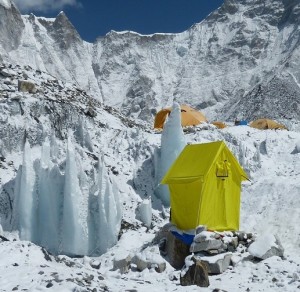 He leads them on through Base Camp. On their left, Nepali expedition teams are clearing rocks and carving flat platforms in the ice on which to set up tents. Clusters of tents are already in place, and set apart from the rest are tiny latrine huts balancing on pedestals of ice or rock – a loo seat suspended over a plastic drum. Beside them, sculptural shards of ice thrust upwards through the debris. On their right flows the Khumbu Icefall – close enough to touch and unfathomably huge. Tumbling steeply down from the Western Cwm is a kilometre wide torrent of dazzling house-sized blocks of ice. It’s on the move, flowing at the rate of about a metre a day, constantly shifting and collapsing, opening yawning new crevasses. It’s beautiful and terrifying. Helicopters skim along the glacier, over the camp and back again, providing photo opportunities for non-trekking tourists. The Icefall is so enormous that the little aircraft dip down behind it, lost to sight from where D&L are standing.
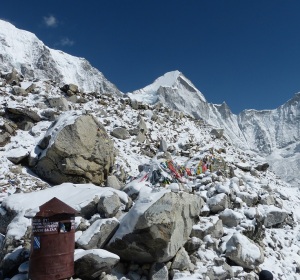 D: Base Camp was so clean. I thought Everest was notorious for being strewn with rubbish. But it was entirely litter-free.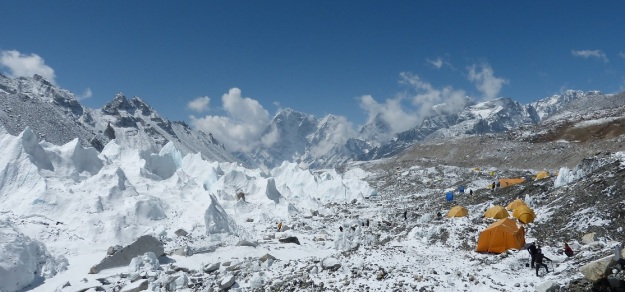
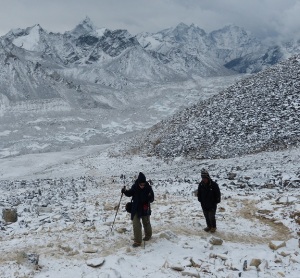 They leave him to his breakfast and set off. There’s a thin crust of snow, a bitter wind and a leaden grey sky which is slowly shifting and cracking. Without the sun the landscape is monochrome and harsh. There is rock and snow. Black and white. Cold and colder.
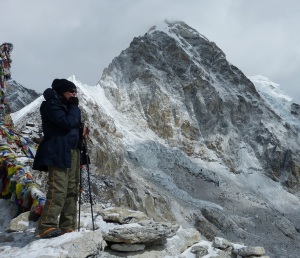 D: It’s amazing! Take photos of everything!
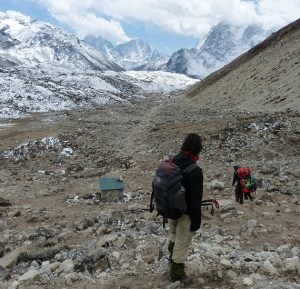 They set off back to Lobuche. Without the sun to melt the dusting of snow, the landscape stays monochrome and the windchill is biting. Once again they across the chaotic maze of glacial moraine.
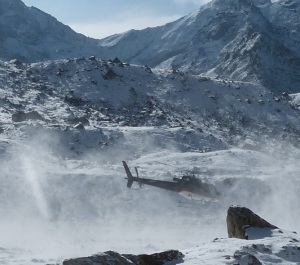 A team of yaks, heavily laden with equipment for Everest Base Camp, drink from Lobuche’s stream. A helicopter lands outside the lodge, throwing up a mini blizzard of fine snow which sparkles in the bright sun.
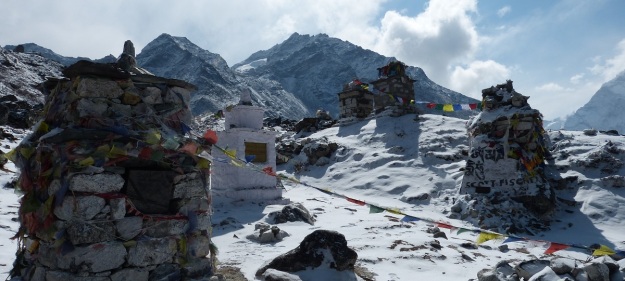
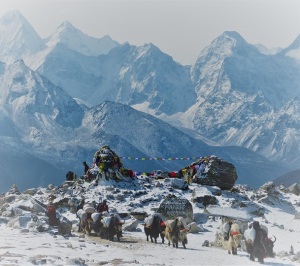 Among them is Scott Fischer, the American mountaineer and guide known for ascending the world’s highest peaks without extra oxygen. In May 1996 he led a group of clients up Everest, assisted by two other guides. After helping others, he summitted Everest late in the day and during his descent was caught in a violent blizzard that took the lives of 8 people, including Fischer. In this spot there is also a memorial to Anatoli Boukreev, a respected Russian Kazakhstani climber and one of Fischer’s fellow guides on that day. After rescuing others, Boukreev did manage to reach Fischer, but he was already dead. Boukreev survived, but was killed in an avalanche while climbing Annapurna 18 months later. One of the largest memorials is to Babu Chiri Sherpa, who climbed Everest 10 times, holding the record for the fastest ascent (under 17 hours), and for the most time on the summit without auxiliary oxygen (21 hours), as well as summitting twice in two weeks. He died on his 11th summit bid of Everest, falling into a deep crevasse in April 2001.
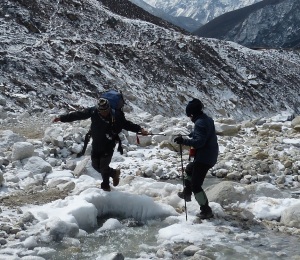 From the memorial field, the trail descends through rock-strewn mayhem to the valley floor. The clouds build, settling on the peaks and draping everything in grey. The temperature drops. Porters toil their way up through the boulders under enormous weights bound for Base Camp. Angtu leads L carefully across an ice-bridge spanning the river, the pair of them slipping and dancing in unison, holding opposite ends of a walking pole.
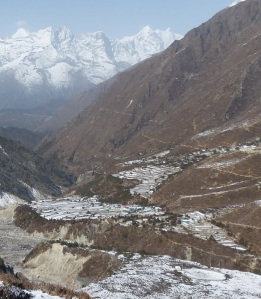
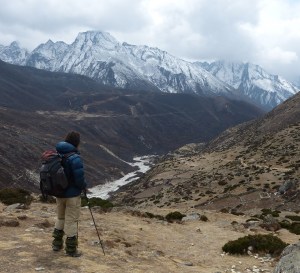 Over a rise they look down into the next valley, a steep-sided groove cut by a fast-flowing river. As they drop lower, the vegetation gets taller.
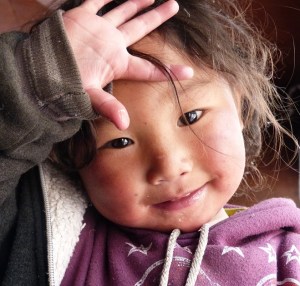 She potters through the door curtain and climbs up onto the bench next to L. They stare at each other for a bit. She puts her face right up to L’s, and laughs. She pokes L. L smiles and pokes her gently back. She giggles and pokes. And giggles and pokes. And giggles. The soup arrives. Her mother shoos her off the bench. The little girl tries to climb out of the window, gives up and disappears back through the curtain. She makes herself busy in the yard throwing cups of water at hens.
 Lodge: The hot water bottles are free. Would you like some?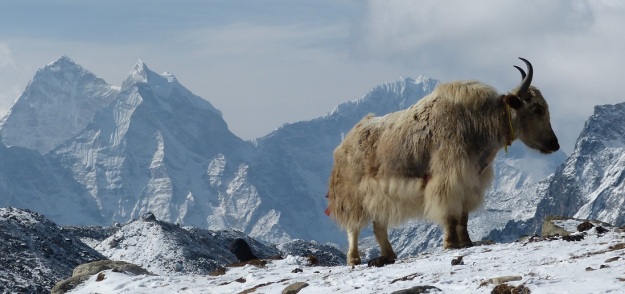
 And Then They Went