Italian Pyramid (4970m) – Gorak Shep (5160m)
28 March
Angtu: Everest Base Camp!
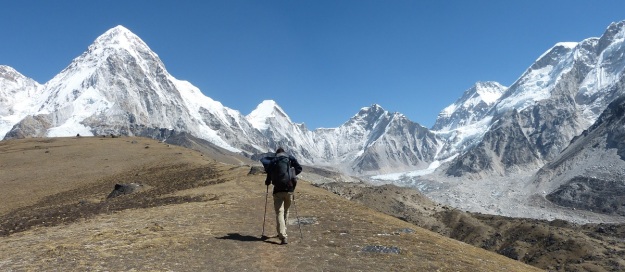
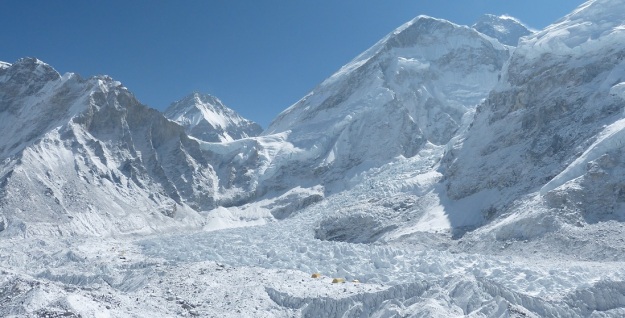
D&L have been walking, under an intense blue sky, across high meadow plateaus with open views. Now they stop and follow Angtu’s gaze to where the distant rubble river of glacier becomes an immense strip of blue-white ice. This is the Khumbu Icefall, and at its edge are the infinitesimally tiny yellow flecks of tents at Everest Base Camp. From this viewpoint they have the world at their feet, and all to themselves. 100 metres or so below them is the busy main trekking trail, a rocky ribbon of dust on the valley floor pinched between the foot of the hill and a wall of glacial moraine. But up here there is no-one – just sunshine, solitude and stupendous Himalayan peaks. It is soul-singing stuff.
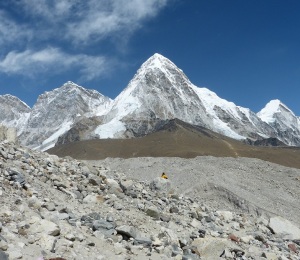 The bliss ends abruptly as their route converges with the main path at a junction of two glaciers. The meeting point is a monumental mess of rubble and rocks and boulders. It’s less than a kilometre across the glacier to Gorak Shep on the far side, but it takes them an hour. The dusty, stony trail weaves and undulates through the maze. Every step is uneven, the ground loose, and dust rises to coat their faces. New paths are forged as old ones fall away, crushed by slabs of dirty grey ice and dragged underground by slow-moving debris.
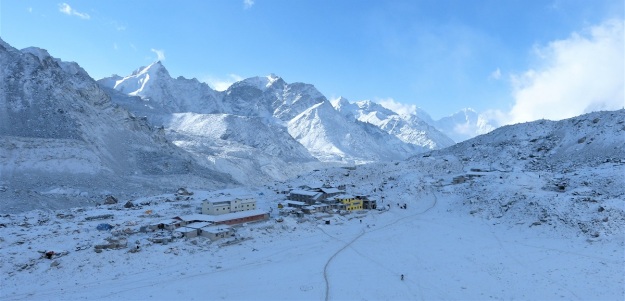
Finally, the blue tin roofs of Gorak Shep appear below them, on the shore of a dry sand lake on which yaks lie resting like clumps of driftwood. At 5,160m, Gorak Shep provides the highest altitude accommodation on earth. Most trekkers spend one night only here, warned by guide books that they are unlikely to sleep soundly due to the altitude and the cold. D&L are in no rush and are well acclimatized – they are here for two nights. The settlement is scruffy and has the tough frontier feel of a place with purpose but no community. No-one lives here year-round.
Angtu has set them some homework.
Angtu: We are really high now. Over 5000 metres. You may get sick. Not sleep well. This afternoon, you must walk at least 100m higher than here, to help you acclimatise.
They promise to do their homework and Angtu heads off to find Phurba who has been banished to the village Porters’ Lodge, despite L&D’s protestations.
Angtu: All the porters have to sleep there. The lodges aren’t allowed to give them a room.
D&L cross the sand-lake desert. A man is galloping to and fro on a palomino pony. It feels more wild-west than ever. On the far side, at the foot of a steep slope, people are gathering water trickling slowly from a spring. Up here clean water is a hard earned resource not to be taken for granted.
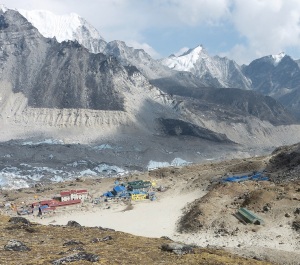 They climb the hill, checking their altimeter, breathing heavily but otherwise comfortable, and stop once they’ve reached 100m. From here they can see the Porters’ Lodge. It is set apart from the other buildings – a long low corrugated-iron barn with no windows, but skylights in the roof. It looks a lot like a cow shed.
Later they ask Angtu if Phurba is OK in the Porters’ Lodge.
Angtu: He’s happy. He says it’s not so full so there’s plenty of blankets for everyone. And the kitchen is warm. He’s found friends. He’s been playing cards.
***
Back at their lodge, a woman reels into the dining room, looking confused and breathless. After hovering in the centre of the room, she sits down at a table.
L: Are you OK?
The woman speaks little English but says that her breathing is bad. A Nepali man joins her. He tells D&L he is the assistant guide of a group who left Lobuche this morning, heading for Everest Base Camp. They had lunch here and left him behind with one member not feeling so well. She needs to lose altitude – returning downhill is the simple remedy. He suggests to her that they should walk back to Lobuche. She refuses – she’ll be fine to get to Base Camp tomorrow. The lodge owner appears with a bottle of oxygen.
Owner: Would you like some?
Woman: What is the cost?
Owner: One hundred dollars an hour.
Woman: Maybe 15 minutes.
She lies down on a bench. Hours later she’s still on oxygen, her breathing now audible and laboured. The assistant guide begs her to return to Lobuche. She refuses. The rest of her group get back from Base Camp. The head guide informs her she needs to lose altitude. He talks about a horse back to Lobuche. She refuses – tomorrow she will get to Base Camp. Her husband implores her. The guide calls his boss in Kathmandu. He insists that she leaves, for her own safety. She refuses. It gets dark.
In the evening she rallies, walks around, eats a little. L smiles at her.
L: How are you?
Woman. Fine. A little better. Thank you.
She returns to her bench, lies down, coughs a lot, cries a little and goes back onto the oxygen.
After supper, D&L’s room is bitterly cold. They pile three quilts on top of their sleeping bags. Outside it is snowing and they fall asleep to the jingle of yak bells.
***
They are woken at 5am by noises from a nearby room. There is a rapid and constant wheezing and rasping and moaning, interspersed by bouts of wracked coughing. It is the woman and it sounds as though she now has full-blown pulmonary edema. Her breathing is shallow. Her lungs are filling with fluid. If she’s not treated soon she could die. She needs to lose a lot of altitude. Now. They lie there feeling helpless, and fretting.
L: Should I go and sit with her? Hold her hand?
D: I can hear voices. She’s with people. She’s not alone.
For the last 12 hours she has been trapped by the darkness. The helicopters fly by sight, and it’s now way too serious to potter back down to Lobuche on a horse. She needs to be in hospital. Urgently. D&L twitch the curtain from time to time, listening to her terrible, laboured, painful breathing and waiting for the sky to lighten. As soon as it does, a helicopter will come. They lie and wait. She pants and moans and coughs. They wait and twitch the curtain. She rasps and wheezes and coughs. D checks the window.
D: It’s getting light.
L: Thank goodness. The helicopter will come. She’ll be rescued any minute.
D: No. She won’t.
L: Why not? Why would you say that?
D: We’re in the cloud. And it’s snowing.
L: Oh no.
At breakfast, L frets and they watch the sky. Angtu tells them the assistant guide sat with the woman all night, administering oxygen. She’s in good hands. She’s with her husband. They are waiting for the heli. There’s nothing more to do.
Angtu: Some clients tell me they’d be happy to die in the Himalayas.
D: But not before their time!
At this altitude, during the busy season there are medical evacuations almost daily. There is a question of whether trekking itineraries are too fast to allow all members of a group to acclimatise. With a medical evacuation there is money to be made by helicopter companies, private hospitals and tour operators. However, putting all that aside, Nepali guides and tour operators tread a tricky line. They have wealthy, demanding clients with high expectations who have paid a lot of money for an experience. Culturally many of these clients will be much more comfortable with confrontation than the gentle courteous Nepalis, who are reluctant to deny their client the experience, or to argue with them. The Nepalis may be the experts in their environment but a paying customer gets what a paying customer wants – right? But the paying customer doesn’t necessarily know best – they’ve probably never had AMS before, and one of the symptoms is confusion – their judgement may well be impaired. In this case, no-one benefits here from letting the client get their way, least of all the client themselves. A client determined to ignore advice and their own physical symptoms, and subsequently becoming life-threateningly unwell, both puts themselves at risk and places a huge burden of responsibility on trekking companies, local guides and others with little or no medical expertise, such as a lodge owner who provides oxygen or a herder with a horse. Not to mention the trauma and disruption inflicted on the rest of the trekking group. Where to draw the line? Who draws it? And how to ensure it’s adhered to? There are no easy answers.
It’s another three long hours before the sky lightens and the clouds lift reluctantly. Eventually, D&L hear, and then see, a helicopter land at the edge of the village. Finally the woman will be rescued. They hope it’s not too late.
 Gorak Shep (5160m) – Everest Base Camp (5364m) – Gorak Shep (5160m)
 Instead of starting from Gorak Shep, most guided groups walk for 3 hours from Lobuche, pausing for an early lunch in Gorak Shep before arriving at Everest Base Camp in the early afternoon, and then heading back to Gorak Shep for the night. It saves a day, keeps costs down and reduces the time spent at over 5000m.
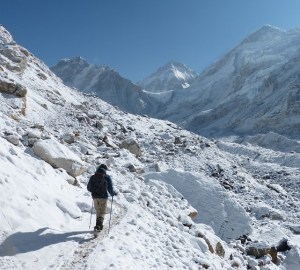
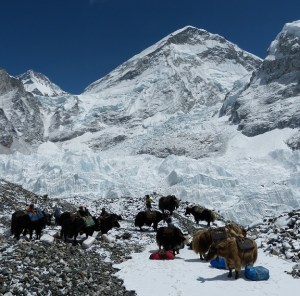 They descend onto the Khumbu glacier at around 10am – the landscape a heavy rolling sea of snow-sprinkled rock-strewn peaks and troughs. Ahead a train of yaks weaves its way calmly through the chaos. The path leads them to a small hillock strewn with prayer flags. They are approached by a tall bearded man speaking heavy accented English with some difficulty. D&L they recognise the accent and switch helpfully into Italian.
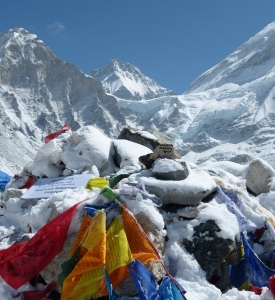 They grin at each other stupidly in disbelief. Angtu returns and leads them over to the pile of stones and prayer flags, where he has dusted the snow off a couple of small rocks on which people have written EBC and the date, in crayon. It’s good enough for the Italian. He gets out his camera phone and then delves once more into his rucksack, bringing out a fist-sized rock on which is written “Majella – Abruzzo – Italy”
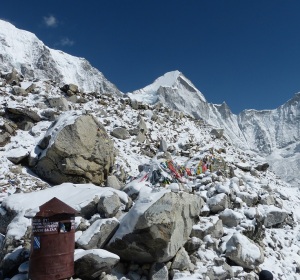
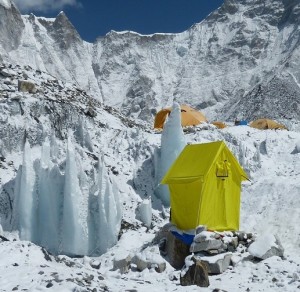 He leads them on through Base Camp. On their left, Nepali expedition teams are clearing rocks and carving flat platforms in the ice on which to set up tents. Clusters of tents are already in place, and set apart from the rest are tiny latrine huts balancing on pedestals of ice or rock – a loo seat suspended over a plastic drum. Beside them, sculptural shards of ice thrust upwards through the debris. On their right flows the Khumbu Icefall – close enough to touch and unfathomably huge. Tumbling steeply down from the Western Cwm is a kilometre wide torrent of dazzling house-sized blocks of ice. It’s on the move, flowing at the rate of about a metre a day, constantly shifting and collapsing, opening yawning new crevasses. It’s beautiful and terrifying. Helicopters skim along the glacier, over the camp and back again, providing photo opportunities for non-trekking tourists. The Icefall is so enormous that the little aircraft dip down behind it, lost to sight from where D&L are standing.
 D: Base Camp was so clean. I thought Everest was notorious for being strewn with rubbish. But it was entirely litter-free.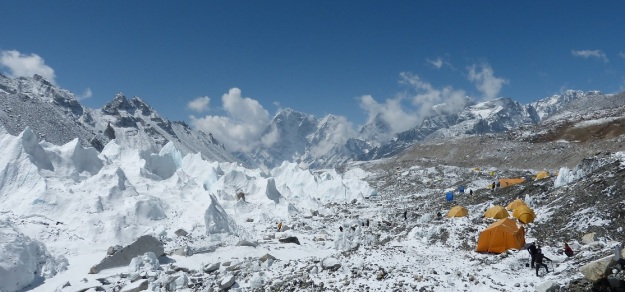
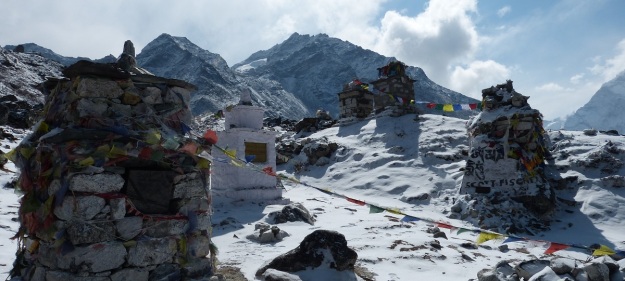
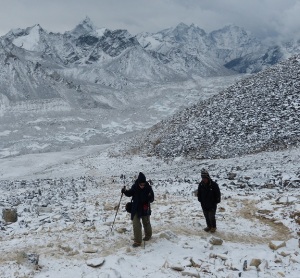 They leave him to his breakfast and set off. There’s a thin crust of snow, a bitter wind and a leaden grey sky which is slowly shifting and cracking. Without the sun the landscape is monochrome and harsh. There is rock and snow. Black and white. Cold and colder.
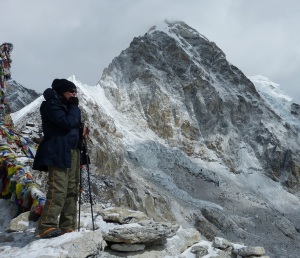 D: It’s amazing! Take photos of everything!
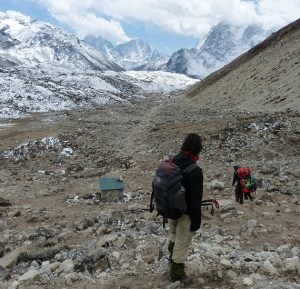 They set off back to Lobuche. Without the sun to melt the dusting of snow, the landscape stays monochrome and the windchill is biting. Once again they across the chaotic maze of glacial moraine.
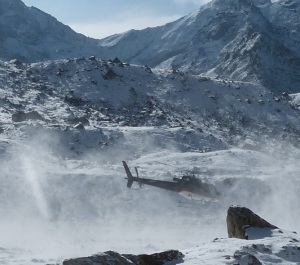 A team of yaks, heavily laden with equipment for Everest Base Camp, drink from Lobuche’s stream. A helicopter lands outside the lodge, throwing up a mini blizzard of fine snow which sparkles in the bright sun.
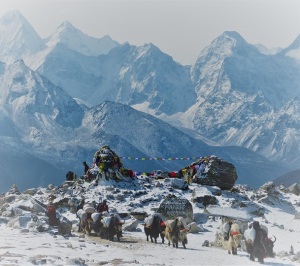 Among them is Scott Fischer, the American mountaineer and guide known for ascending the world’s highest peaks without extra oxygen. In May 1996 he led a group of clients up Everest, assisted by two other guides. After helping others, he summitted Everest late in the day and during his descent was caught in a violent blizzard that took the lives of 8 people, including Fischer. In this spot there is also a memorial to Anatoli Boukreev, a respected Russian Kazakhstani climber and one of Fischer’s fellow guides on that day. After rescuing others, Boukreev did manage to reach Fischer, but he was already dead. Boukreev survived, but was killed in an avalanche while climbing Annapurna 18 months later. One of the largest memorials is to Babu Chiri Sherpa, who climbed Everest 10 times, holding the record for the fastest ascent (under 17 hours), and for the most time on the summit without auxiliary oxygen (21 hours), as well as summitting twice in two weeks. He died on his 11th summit bid of Everest, falling into a deep crevasse in April 2001.
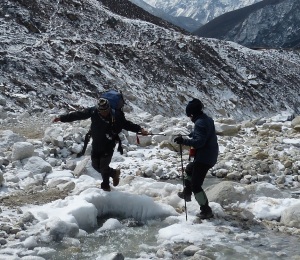 From the memorial field, the trail descends through rock-strewn mayhem to the valley floor. The clouds build, settling on the peaks and draping everything in grey. The temperature drops. Porters toil their way up through the boulders under enormous weights bound for Base Camp. Angtu leads L carefully across an ice-bridge spanning the river, the pair of them slipping and dancing in unison, holding opposite ends of a walking pole.
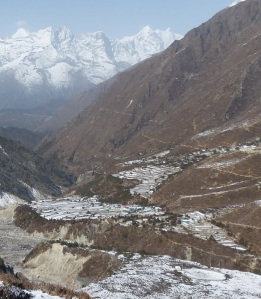
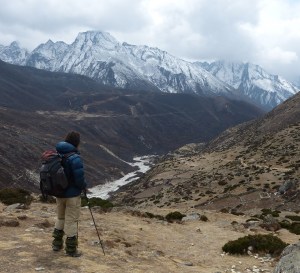 Over a rise they look down into the next valley, a steep-sided groove cut by a fast-flowing river. As they drop lower, the vegetation gets taller.
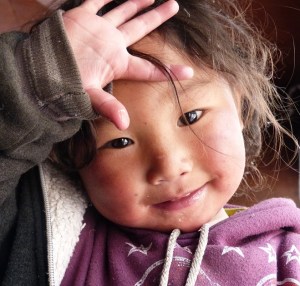 She potters through the door curtain and climbs up onto the bench next to L. They stare at each other for a bit. She puts her face right up to L’s, and laughs. She pokes L. L smiles and pokes her gently back. She giggles and pokes. And giggles and pokes. And giggles. The soup arrives. Her mother shoos her off the bench. The little girl tries to climb out of the window, gives up and disappears back through the curtain. She makes herself busy in the yard throwing cups of water at hens.
 Lodge: The hot water bottles are free. Would you like some?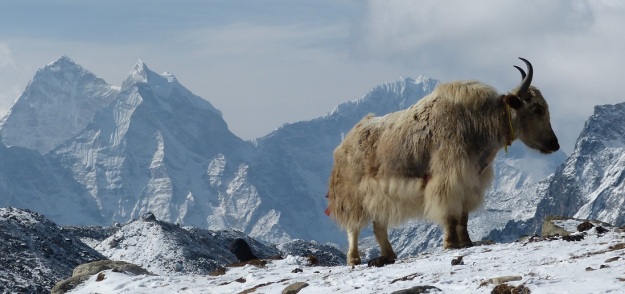
 And Then They Went