
It is time to leave Bangkok. They take a taxi to the metro, and a metro to the bus station. The bus station is nowhere to be found. They ask, and are offered a taxi.
D: That’s ridiculous. It must be around here somewhere. We’ll keep looking.
They take a taxi to the bus station.
Mo Chit bus station has different counters selling tickets to different destinations. There are 59 counters on the ground floor, and 58 on the first floor. Thankfully none on the second floor, but a further 112 on the third floor.
L: Blimey – any idea which counter we need?
D: Err….I’ll ask. We’ll probably need a taxi to reach it.
They flag down a passing official and are pointed to a counter, which miraculously is right where they are standing. Less surprisingly, considering the number of counters, there are no queues.
The journey to Sukhothai takes 7 hours. The landscape is flat and carpeted with rice paddies resembling vibrant green meadows or waterlogged lawns or bare muddy swamps. Along the roadside, suburban houses intermingle with tin-roofed wooden shacks. Some are homes, others garages, workshops, barns, shops, restaurants, bars, roadside stalls, bus shelters, shaded rest areas, or outhouses. Most are in use, a few are abandoned and half dismantled, the materials used to build another shack next door.
They cadge a lift to their hotel in a tuk-tuk piled high with a tour group’s luggage. They’ve picked the place for its proximity to the temples, and the pool. They climb out of the tuk-tuk, and are greeted enthusiastically with a smile, a cold drink and a banana cupcake. They are still in the car park, holding their bags.
L: Lovely, thank you. Delicious. Umm, D, can you just hold my cupcake while I take my rucksack off?
D: (mumbling through cake crumbs) Sure, if you hold my drink.
L: Thanks. But can you hold my drink too? And your drink? And your cupcake? And my cupcake? And the day pack? But don’t put the laptop bag down in that puddle.
They check in, admire the polished wood floors of their large room, agree that the smell of drains from the bathroom really isn’t that strong and that they don’t need wifi anyway, and head off to the bar for a drink. The wooden deck of the restaurant sits over a lily pond, and as dusk falls they listen happily to the frogs and slap mosquitos from their bare arms and ankles.
***
The next morning is sunny, the temperature pushing 30 degrees. They are on a mission. The ruined temples of central Thailand’s Sukhothai are all that remains of the capital of a vast 13th century kingdom. Although the ancient city walls are under 2km square, there are nearly 200 ruins dotted around a much wider area. They stop at the Historical Park entrance to hire bicycles for the day.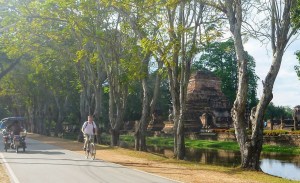
D: Right, it’s 30 bhat per bike.
L: Hold on a minute. Don’t do anything hasty. We may need to bargain. Let me work it out. Oh. That’s 75 pence. Go ahead.
They start with the museum, where they find a vast table with a 3D plan of the site and surrounding countryside, and buttons to press to show the location of each temple in little red lights. They press all the buttons.
L: Who was Ram-kam-haeng? This museum’s named after him.
D: He was the king who really put this place on the map. He didn’t found it, but he massively expanded the kingdom. And encouraged Theravada Buddhism here. And invented Thai writing.
L: The squiggles?
D: The squiggles. And after he died, the empire was never quite the same again.
In one corner of the museum, through an open doorway, they spot an unremarkable flight of carpeted stairs. Despite appearances, it does not lead to the museum’s administration office. Above the doorway, a large sign proclaims “The Mystic Tunnel-like Stairway Corridor”.
L: How exciting! Follow me.
At the top of the stairs is a blank wall.
L: Oh. That’s it. Is it a joke? I don’t understand. It’s not very mystic, or tunnel-like. It’s not even a corridor! Just a stairway. And it doesn’t go anywhere!
D: What’s on the walls?
L: Just copies of some drawings or engravings.
D: (reading a sign) They’re pictures of the life of Buddha – the oldest existing examples of Thai drawing – and they were discovered in a mystic tunnel-like stairway corridor at one of the temples here.
L: Let’s go and find the real one.
D: Let’s.
The Historical Park is immaculate and peaceful. There are plenty of visitors, but no great crowds. Great avenues of trees and clumps of forest provide ample shade and many of the temples are surrounded by moats with water-lilies. Shrines and incense sticks and votive candles decorate steps and ledges. After all the glitter and gold and architectural twiddles of Bangkok’s temples, this is a world apart, of warm bare brick and stone and grass and water and smooth unadorned grey statues. It’s a great big drink for the soul.
Right at the centre of the site is Wat Mahathat.
D: This is the biggest and most important temple. It’s got over 200 chedis and….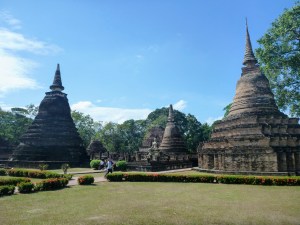
L: What’s a chedi?
D: It’s a stupa.
L: Yes, but what IS one?
D: It’s a bell shaped tower – you’ve seen them at the temples in Bangkok.
L: Yes, but what ACTUALLY is it?
D: Oh, I see what you mean. Of course. Umm…I don’t ACTUALLY know.
L: Oh.
D: I will in a minute. (He taps his phone). Got it. It’s where you put relics of important people.
L: Thank you. Carry on.
D: Thank you. I shall.
L: Thank you. Please do.
D: Shut up now.
The chedis lie scattered across the landscape like huge bells. Amongst the temple columns they admire the beauty of two great seated Buddhas, serene with eyes closed, the elongated fingers of their elegant right hands pointing down to the earth, while their left hands are relaxed, palm up, in their laps. Nearby are two towering standing Buddhas, 9 metres tall, with graceful oversized hands reaching to their knees.
They cycle slowly along the quiet lanes criss-crossing the park, stopping to marvel at the immense single chedi of Wat Sa Si rising from the centre of its reservoir moat, the beautiful, but much restored elephants at the base of Wat Sorasak, and the prickly domes of the originally Hindu Wat Si Sawai.
They head out past the crumbling city walls and dry moat before finding what they are looking for.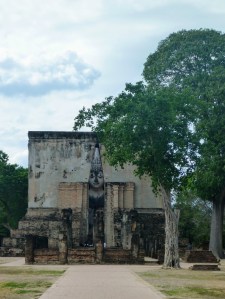
L: He’s staring.
D: I think he’s just got mossy eyelids.
At the end of the causeway crossing a moat is the square stone building of Wat Si Chum. In the centre of the facing wall is a narrow vertical slit running almost the full height of its 15 metre façade. Through the slit, a gigantic face is visible. They approach, and pass through the entrance into an open-roofed courtyard which is entirely filled with a colossal seated Buddha. He fills the space like Alice in Wonderland after knocking back the growing potion, and looks sleepily down at them through half closed eyes.
L: He really is the biggest, most beautiful Buddha. Just look at him.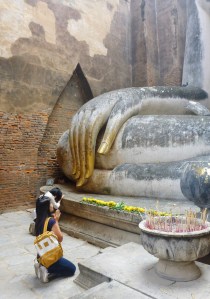
D: (tapping his phone) He’s 15 metres high.
L: (not listening) He’s so beautiful.
D: And 11 metres wide.
L: (not listening) He’s just so lovely.
Two visitors kneel at his feet, hands in prayer, before rising, lighting incense sticks and leaving him a bunch of marigolds.
L: He’s got gorgeous golden nail varnish.
The Buddha’s left hand is cupped gently in his lap, thumb nail gleaming. The long slender fingers of his right hand flow down from his knee like a waterfall towards the earth, and have been gilded in gold leaf by visiting worshippers. It is silent within the walls and the air is heady with incense.
D: I’ve found the Mystic Tunnel-Like Stairway Corridor!
L: (not listening) D’you think the circle of sky above his head looks a bit like heaven?
D: But the gate’s locked.
L: (not listening) His pose shows his moment of enlightenment.
D: It’s where they found all the drawings of the life of Buddha.
L: (not listening) Don’t you think he looks enlightened, with his head in the sky like that, so that you can hardly look at him? It’s like staring at the sun.
D: The corridor’s supposed to run through the inside of the walls. Apparently the kings used to hide in here and speak to the people through a hole. Everyone listening thought it was the Buddha talking.
L: (not listening) I think I’m feeling a bit enlightened. I wish I had some marigolds.
D: I’m trying to photograph him for you, but I can only get little bits of him in. We’ll have to put him together later, like a jigsaw.
L: (not listening) Take a photo.
They head on out into the countryside. L’s state of enlightenment does not seem conducive to riding a bicycle. D stops and waits in exasperation.
L: What! It’s hot!
D: But you’re going so slowly!
They reach the foot of a hill, and a stone-paved footpath leading up it. L looks unconvinced.
L: It’s miles!
D: It’s a very small hill indeed.
Minutes later they are at the top. There is a tall and crumbling standing Buddha with his right hand raised in a posture of fearlessness, and a view back across miles of flat forested plains, but surprisingly not a single one of Sukhothai’s other 192 ruins are visible.
D: This is Wat Saphan Hin. King Ramkamhaeng used to ride up here on his white elephant to worship the Buddha. It’s twelve and a half metres high.
L: Gosh! The elephant?
D: The Buddha. It was called Ruchakhari.
L: The Buddha?
D: The elephant.
On their way back, D stops and points at the verge.
D: That’s disappointing. Fly-tipping.
L: But they’re all shrines. This must be where shrines go to die.
Little broken temples lie higgledy-piggledy in the long grass, guarded by a tiger with no head. It seems an undignified end for objects once worshipped.

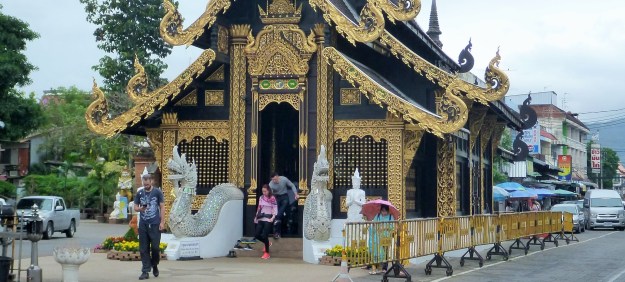


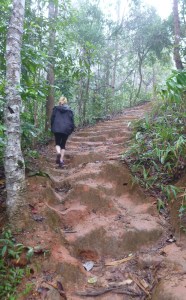 They pick up the path again, which is now smaller and much steeper, slick with mud. They climb slowly upwards through the forest, panting. The ground glitters with flakes of quartz washed clean by the rain, and they find a steep flight of mud-carved stairs. The world is silent save for their breathing and the patter of water on leaves.
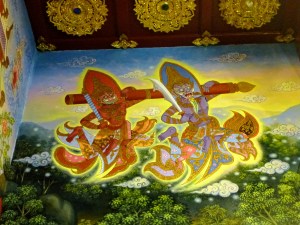
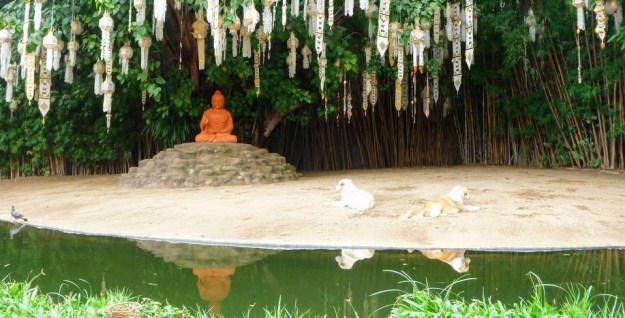
 They have reached Wat Phan Tao, which is built entirely of teak. Inside, the dark wood ceiling is supported by huge wooden pillars, and on the altar a huge golden Buddha glows in the gloom. Lines of copper alms bowls fill one aisle, making music as the devout drop their pennies. Outside, an artificial island is decorated with prayer ribbons and lanterns, and an orange Buddha sits in meditation guarded by several of the town’s stray dogs who have taken up residence. It is a fiercely protected piece of canine real estate, and interlopers are seen off with growls and yelps.
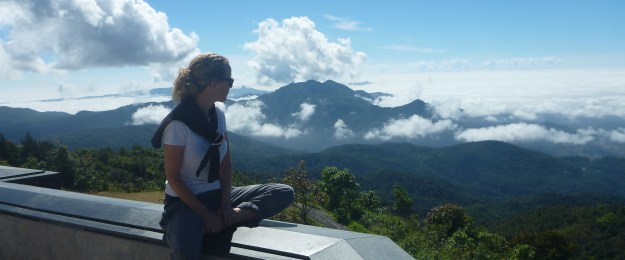
 Near the summit are a pair of modern temples set amongst immaculately tended gardens and dedicated to the King and Queen. It is popular with locals, and on a sunny Saturday there are lots of visitors, flocking here from Chiang Mai to enjoy the views and the cool air. At the top it is a mere 17 degrees, and Thais are bundled up in thick jackets, scarves and hats.
 They drive north, to Chiang Dao, searching for a “proper” mountain. One without a car park on top. Chiang Dao’s mountain, Doi Luang, is rocky and steep with great scenery and varied vegetation. At 2175 metres it is Thailand’s third highest summit, and apparently the country’s best mountain hike. Most people do it in two days, camping for a night just below the summit. But there is only a small weather window – one day of sunshine – before the rains promise to return.
 They return to their room, appropriately known as The Nest. Their little bamboo cabin is tucked into the undergrowth at the far corner of a lush garden. It is charming and smells of damp straw.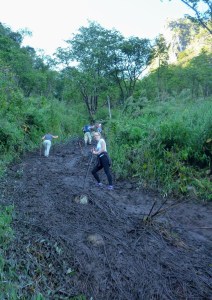
 As his wiry frame treads nimbly up the uneven path he tells them that he only guides hikes when he can be spared from his father’s farm. The two of them work the land entirely by hand, except for ploughing, producing 5 crops a year – 2 of rice and 3 of carrots and cauliflower. They sell their produce not only locally but also in Chiang Mai and sometimes even in Bangkok.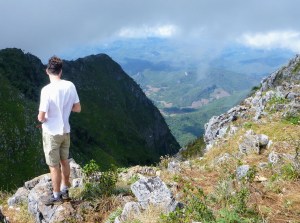


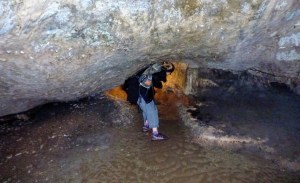 She lights the lamp and dives into the dark. They follow the glow of the lantern into a series of huge caverns and past weird-shaped rock formations, punctuated with her little cries of “slippery!” and “watch your head!”. Every cavern seemingly has multiple tunnels leading to and from it. It’s a real maze. They come to a halt and she waves her lantern at a small hole in the wall, less than a metre square. She smiles. L smiles back and shares the joke, agreeing.

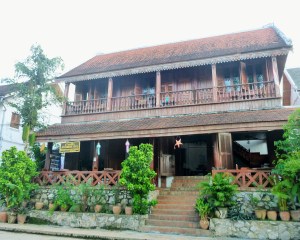 Twenty minutes later, they are stepping out of their flip-flops at the foot of the stairs leading to the Mekong Charm Guesthouse. They are welcomed warmly with watermelon juice, then led barefoot across squeaky varnished wood flooring to their first-floor room – a gleaming dark-wood box with windows on two sides and a balcony.
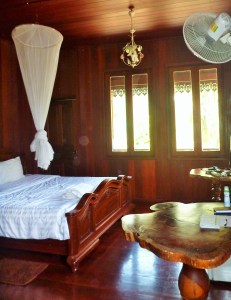 They are here for 4 nights and love everything about it. The bed is huge and comfortable, the room so eccentrically dark they find clothes from the wardrobe with a torch, and the shower, with luxury shower head, tremendous pressure and masses of hot water, is designed to wash the entire bathroom floor before draining in the opposite corner, under the sink.
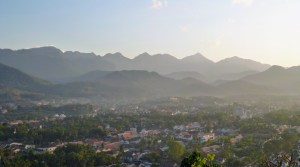 Luang Prabang is seriously low key. There are no high rise buildings – from above, the French colonial architecture seems to just melt back into the surrounding jungle. There are lots of tourists, of the quiet, earnest sort.
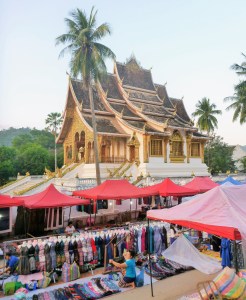 Running down the centre of the tongue, it has restaurants and shops and every evening a huge outdoor market selling brightly coloured textiles, crafts and good quality souvenirs. Further on there is street food – aromatic grilled meats seasoned with lemongrass, freshly pressed fruit juices and smoothies, and melt-in-the-mouth coconut pancakes served in little boats of banana-leaves. People stroll, chat, shop and eat. There is no traffic and no loud music.
 D: Did things pick up?
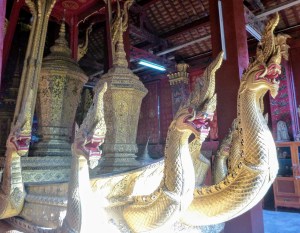 D: Never mind all that. What on earth is this?
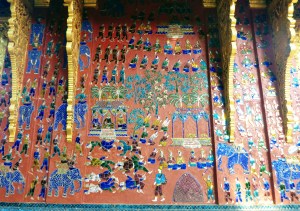 They wander through the grounds. Several of the smaller temples, and the rear wall of the main temple, are decorated with more mosaic scenes of vivid coloured glass. There are armies and elephants, temples and trees, owls and peacocks. The designs are both simple and complex and all of them beautiful.
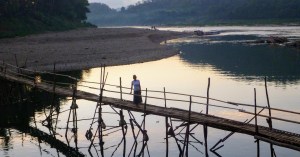 There is still time. A rickety bamboo footbridge bridge crosses the river from the tip of the town’s tongue to the overgrown bank beyond. This is the mouth of the Nam Khan, where it joins the mighty Mekong. On the far side there is no-one, apart from a woman sitting on a bamboo platform. Beside her, miraculously, is a cool-box.
 They find a boatman to take them across the Mekong and upstream a little way. The sloping river banks are neatly planted with lush green vegetable gardens.
 In a clearing is a garden, pretty with bougainvillea, in which stands a small plain temple and a couple of cottages. Orange robes hang drying from windowsills. Under a tree, two young monks are playing with a puppy. Inside the temple they find the uneven walls painted with dramatic scenes: a great gale, a fierce battle, and a desperate shipwreck complete with sharks.
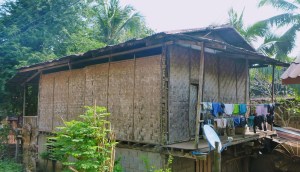 The trail becomes wider and turns concrete as they enter the village of Ban Xieng Maen. Bamboo, wood and palm leaf dwellings line the track, single rooms with corrugated iron roofs and satellite dishes. Chickens scratch in the dust, dogs roam busily and cheerful children wave in greeting.
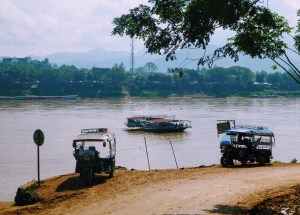 The road descends to the river where a ferry is arriving. Two tuk-tuk drivers are waiting for customers, dozing in hammocks slung in the back. The rusty twin-hulled barge reaches the shore. It has ramps protruding each side like wings. An SUV and cluster of mopeds rattle over the ramp and off, and another cluster rattle on. Garden chairs and benches are set around the edges and at each prow is a small shrine, with a food offering wrapped in banana leaves and marigolds.
 L: Did you know the silkworm makes a cocoon from one continuous line of silk thread, so it can turn itself into a moth?


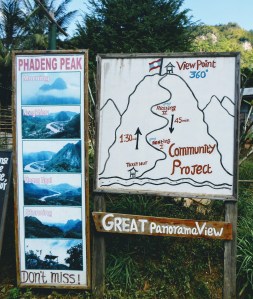 L: I’ve been reading the signs.
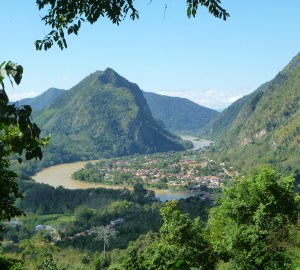 They arrive in Nong Khiaw the previous day, after a four hour minibus ride on quiet, mostly good roads sprinkled with a few potholes of the size that you drive into, and then out of again. The little village straddles the Nam Ou River and the scenery is so magnificent that they just want to choke and fall over.
 D: I think I can bear it.
 The narrow path climbs steeply through the forest, ducking under madly spiralling vines. They manage not to step on any bombs. At the top, they are in thick cloud, swirling around them. There is nothing whatsoever to see.
 D: Officially?
 D: OK. But who dropped all the bombs on Laos?
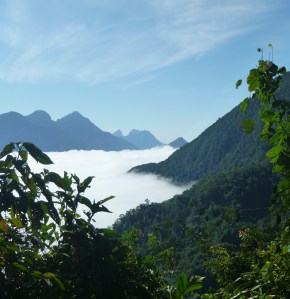
 The sun is melting the white layers into wisps to reveal the vivid blue sky behind. The signs were right – they have 360 degree views of the most bombed, and surely one of the most beautiful, countries in the world. There is space all around them, into which they feel they could fly. On every horizon lush green mountain ridges jut and soar, cut through by fertile valleys, rice paddies, and the lazy curves of the coffee-coloured Nam Ou River, laid out below their feet.
 D: We’re here. Tham Pha Thok.
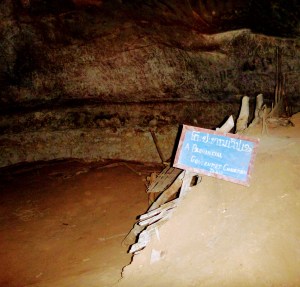 L: This was lived in by villagers, and also by a lot of the provincial government, during all those years of bombing. You can almost imagine it, can’t you? It’s a good safe spot – completely invisible from the outside, and close to a stream.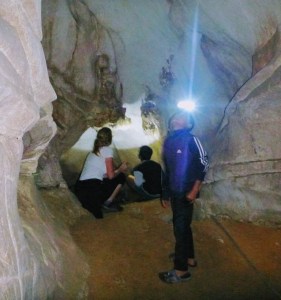

 Big: See? This village too, has got electricity now. Just last year. Like my village.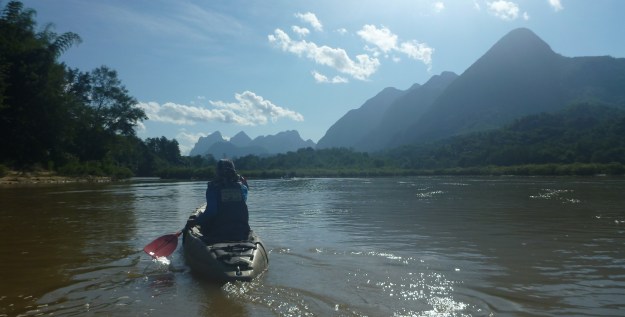

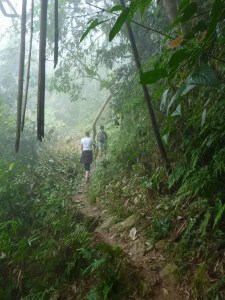 They hear voices above them in the forest. They are climbing steeply through the trees on a narrow path and the cloud has rolled in leaving everything blurred and dripping. Lia stops talking and listens. A dog barks.
 D: So who are they?
 The ridge flattens and they emerge onto an orange dirt road. They are now above the cloud, in bright sunshine under a vivid blue sky.
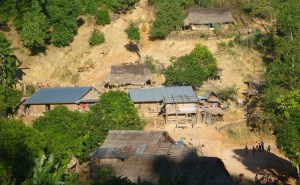
 The village spreads up both sides of the pass. Single room dwellings of wood and bamboo and palm thatch contain fourteen families and a menagerie of livestock. About half of the houses have corrugated tin roofs but all other building materials have come straight from the forest. They head to the far upper edge of the village, and stop.
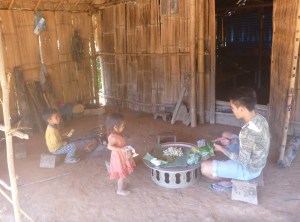 They enter their new home. Under a covered porch two small children sit on tiny stools around a fire in the middle of the earth floor. Nevin is five, but tiny, and his sister Ladah is two. L & D greet their mother, who is their host. She nods shyly at them.
 Their house has a spotlessly swept earth floor, split-bamboo walls and a palm thatch roof. It is cool and airy. A raised bamboo platform covers two sides. This is where they will sleep. L lies back. Despite the absence of a mattress it is surprisingly comfortable. Through the paper-thin wall a cockerel crows loudly. It is roosting under the eaves of their hut. Dangling from the ceiling they notice, to their surprise, a lightbulb.
 The views are glorious – wooded peaks, patchworks of upland meadows and a sea of cloud blanketing them from the rest of the world below. In the fold of a valley lies another little village, spreading down the slope like a landslip. The boys spot figures on the opposite hillside, as tiny as beetles, maybe 500 metres away as the crow flies. They call across and a long conversation ensues, phrases floating to and fro, bouncing from one hill to another, as natural as a phone call, with no need for technology.
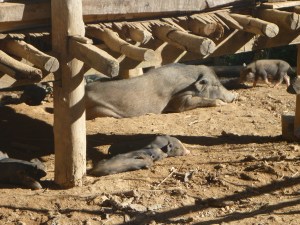 D: Well, for a start, with no shops there’s no packaging. Or carrier bags. That helps.
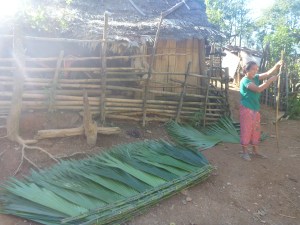 A woman is weaving palm leaves to make sections of roof. She laughs and blushes with pleasure as they admire her work. Another woman and her daughters return from the fields with baskets bulging with marrows.
 On the hillside behind their hut, beyond the edge of the village, is a large flat clearing. From here, they have an awesome 180 degree panorama of peaks spread out at their feet and of the sun sinking behind the mountains, washing their own hilltop in gold. It is blissfully peaceful and utterly stunning. They stand there gawping and wearing out their camera. There is a chuckle.
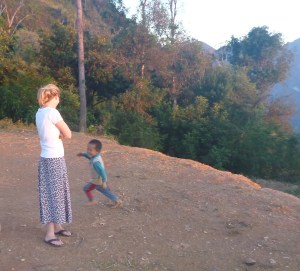 They run circles around her, chanting and laughing. L laughs with them, whirling within their circle but keeping her distance, frightened of frightening them.
 They sit around the fire in the dark. Puppies and hens tiptoe close to the embers. Lia brings out supper. There is barbecued chicken, boiled marrow, chicken and marrow soup, and rice.

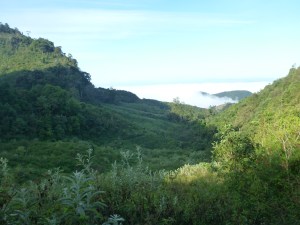 They pause for a drink. The slopes in all directions have long ago been cleared of trees, and now the forest is reclaiming them. Lia waves an arm expansively.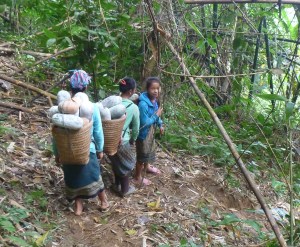
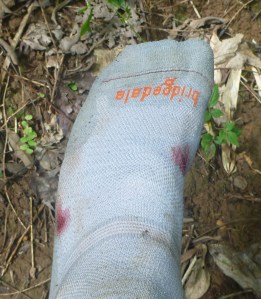
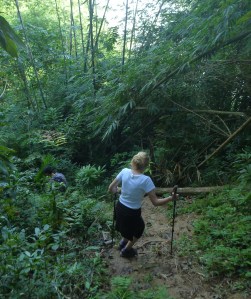 Lia: All the falang (foreigners) fall over on this path.
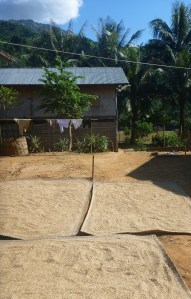
 They arrive at an immaculately shorn green meadow on which sits a collection of traditional woven-leaf houses with palm thatched roofs. There is electricity to each house. They pass several blocks of public toilets with water points nearby and larger, brightly painted buildings of blockwork with tin roofs. Livestock are tidily contained in pens. Berries are spread out to dry on a grass mat in the sun. It feels a little like an authentically themed holiday park.
 D: But why put people of different ethnic origins together like this?
 Lia: After this, you are going to Angkor Wat, right? In Cambodia?
 Lia: And the Plain of Jars – have you read about that?


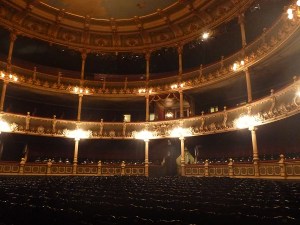

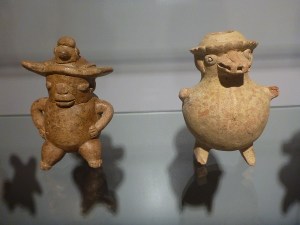


 utiful Manuel Antonio National Park, on Costa Rica’s Pacific coast, is not a rambling wilderness. It is tiny – almost municipal in size, with some 9km of well-maintained concrete paths, thoughtfully placed benches, litter bins and WCs, a ticket office and guides touting for business. And volumes of people to match. From the park gates, a chain of accommodation, ranging from scruffy hostels to B&B
 s to boutique hotels with sea views, stretches unbroken for 7km along a winding hilly coast road which follows a wooded ridge northwards to the harbour village of Quepos.
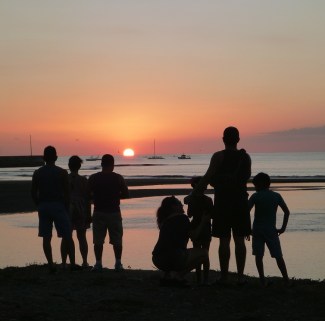 luck, revellers and tourists alike are entertained by raccoons or tiny white faced capuchin monkeys hoping to snatch a banana skin or an unguarded empanada.
 And Then They Went